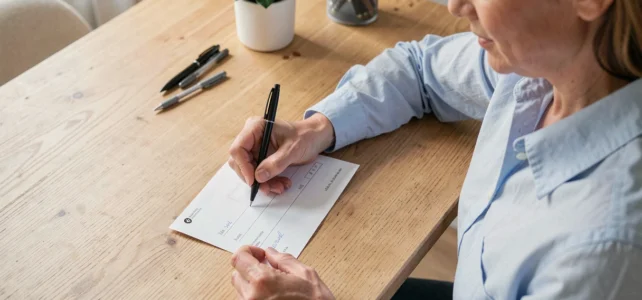
Filling out a check from La Banque Postale involves the same mandatory details as any French bank check: payee, amount in figures, amount in words, place, date, and signature. No special formula or additional mention is required on the front. However, errors that lead to rejection at the agency are common and often related to details that are underestimated.
Discrepancy between amount in figures and in words: what La Banque Postale specifically rejects
The banking rule is clear: in case of a difference between the amount in figures and the amount in words, the amount in words prevails. This does not mean that the check will go through without issue.
In practice, even a minor discrepancy between the two amounts can lead to rejection at the counter or a return after processing. Writing “150” in the figures box and “one hundred forty” on the words line, for example, creates an inconsistency that the advisor or the optical reading system will detect. The check is returned, the payment is not honored, and the payee must request a new instrument.
Another common case: forgetting the cents in words while they are included in figures. If the box shows “250.30 €” but the words line only indicates “two hundred fifty euros,” the bank may consider the actual amount to be 250 euros and ignore the cents, or reject the check for inconsistency.
To learn how to fill out a check from La Banque Postale without falling into this type of trap, a good habit is to first write the amount in words (which prevails), and then accurately transcribe the same amount in figures in the designated box.

Filling out the back of the La Banque Postale check: the oversight that blocks cashing
The back of a check is often neglected by the issuer. However, it is on the back that the payee must affix their endorsement before depositing the check.
The endorsement involves signing on the back and, in some cases, indicating their account number. Without this signature, the payee’s bank may refuse the deposit. This refusal is common when depositing at the La Banque Postale counter or via a check deposit slip.
What the issuer must check before handing over the check
The issuer typically writes nothing on the back. However, it is useful to inform the payee that they will need to sign on the back before deposit. Many rejections come from checks deposited without endorsement, simply because the person receiving the check does not know they need to sign it.
The crossed check, which is the standard at La Banque Postale, cannot be endorsed to a third party. Only the payee designated on the “payable to” line can cash it. If this line is left blank, anyone could theoretically present themselves as the payee. Leaving the order line blank is one of the riskiest errors in terms of fraud.
Order of filling and ink: two technical details that matter
Several recent guides recommend a specific order of filling to limit errors:
- Start with the “payable to” line with the full name of the payee, without abbreviation. An incomplete or misspelled name complicates cashing.
- Then write the amount in words on the large line, crossing out the remaining space with a horizontal line to prevent any fraudulent additions.
- Transcribe the amount in figures in the designated box, checking for consistency with the amount in words.
- Indicate the place and date, then sign last, as the signature validates all the information written.
Signing before filling out the rest of the check amounts to validating an incomplete document. If the check is lost or stolen in the meantime, a third party could complete the missing fields.
The choice of ink is not trivial
The ink must be indelible, blue or black. An erasable ink pen (like Frixion) allows anyone to modify the amount or the payee with a simple source of heat. Cases of fraud related to this type of pen have been documented in the press. La Banque Postale, like other institutions, does not accept responsibility for the consequences of a check written with non-permanent ink.
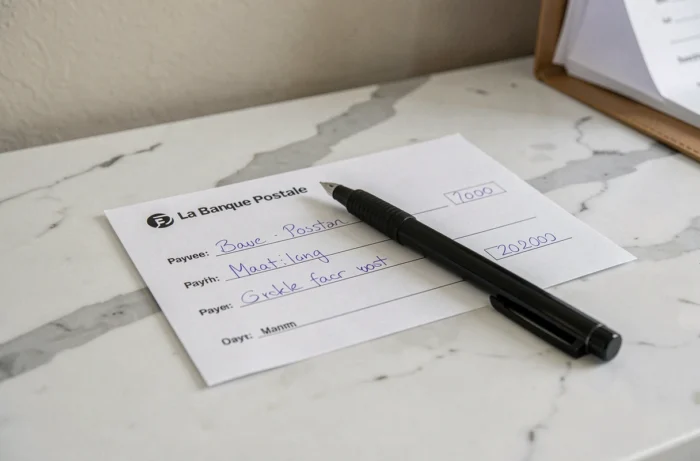
Check deposit slip La Banque Postale: what changes at deposit
Filling out the check does not stop at writing. When the payee deposits the check, they generally need to fill out a deposit slip that accompanies the payment instrument.
This slip requests the depositor’s account number, the amount of the check, the name of the issuer, and sometimes the check number (visible on the MICR band at the bottom). Omitting this information or providing it in an illegible manner can delay cashing by several days.
For La Banque Postale customers depositing at a post office counter, the paper slip remains the norm. However, some partner online banks offer deposit procedures by mail with printable slips. The readability of the check and keeping a copy (photo or photocopy) are recommended in all cases.
Validity period and funds
A check issued in metropolitan France is valid for one year and eight days from the date written. After this period, the bank will refuse it. Backdating or postdating a check is prohibited, even if this practice remains common. The account must be funded at the time the payee presents the check, not just at the time of writing.
A check without funds exposes the issuer to a banking ban, with registration in the central check file. This consequence applies to all institutions, including La Banque Postale, and remains in effect until regularization.
The check still holds a place in payments in France despite the rise of transfers and cards. For those who still use it, diligence in filling it out remains the only safeguard against rejection or fraud. Any empty space left on the order line or on the amount in words constitutes an exploitable flaw, and no bank will compensate for the issuer’s negligence.