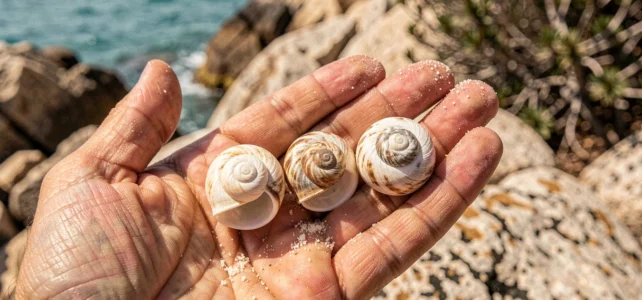
The eye of Saint Lucia is not a shell in the strict sense. It is the calcareous operculum of Bolma rugosa, a marine gastropod that sheds it as it grows. Once detached, this operculum rolls in the waves, polishes against the sand, and sometimes ends up washed ashore on the Corsican coast. Finding it requires knowing where to look, but also when and how to search without disturbing a coastal environment already under pressure.
Collecting opercula on Corsican beaches: what the regulations really allow
Corsica has several natural reserves, biotope protection orders, and Natura 2000 areas where collecting shells or marine debris may be prohibited or regulated. Before any search, it is worth verifying the protection status of the targeted beach.
The distinction between an operculum washed up on the sand (considered a natural debris) and an active collection in a protected area is not always clear in the texts. Some coastal guards tolerate the collection of washed-up opercula, while others penalize any gathering within the perimeter of a reserve.
Before searching for eyes of Saint Lucia in Corsica, it is better to check the protection status of the targeted beach. The natural reserves of Scandola, the Strait of Bonifacio, or the Agriates impose varying restrictions depending on the areas. Outside of these perimeters, collecting washed-up opercula does not pose any particular legal problem.
Southern Corsican beaches favorable for eyes of Saint Lucia
The south of the island concentrates the spots most frequently mentioned by locals. The area from Bonifacio to Sainte-Lucie-de-Porto-Vecchio appears in the majority of testimonies, with several beaches having a favorable substrate.
- Stagnolu, south of Porto-Vecchio, features a sandy bottom mixed with gravel where opercula settle after rough seas
- Pinarello, further north on the eastern coast, offers a sheltered cove where the backwash concentrates small calcareous elements along the high tide line
- The Gulf of Bonifacio, particularly the coves accessible on foot from the Pertusato road, regularly yields finds after a day of strong winds
The Grand Capo, on the road to the Sanguinaires north of Ajaccio, remains a classic. Walkers have been searching for eyes of Saint Lucia there for decades. The high foot traffic reduces the chances of finding larger pieces, but small opercula are common.
Upper Corsica and Balagne: more random searches but less competition
In Upper Corsica, Balagne offers a different search terrain. The beaches of Bodri, Ghjunchitu, Algajola, and L’Île-Rousse are cited as favorable areas, with a more unpredictable character than the southern spots.
This is partly due to geomorphology: the rocky bottoms where Bolma rugosa lives are more dispersed along this coast. The opercula arrive on the sand irregularly, often after a swell episode.
The Gulf of Saint-Florent and the Agriates desert constitute another area to consider. Saleccia and Lotu, accessible by track or by boat, are beaches with limited foot traffic. Fewer visitors mean fewer collectors, which mechanically increases the chances of finding intact opercula on the sand.
The Cap Corse, an underestimated area
Some coves in Cap Corse, particularly on the west coast between Centuri and Nonza, sporadically produce eyes of Saint Lucia. Bolma rugosa is present there, but the beaches are often composed of black pebbles or gravel, making the search visually more challenging. The white operculum with orange spirals is easier to spot on light sand.
Searching at the right time: rough seas as an ally
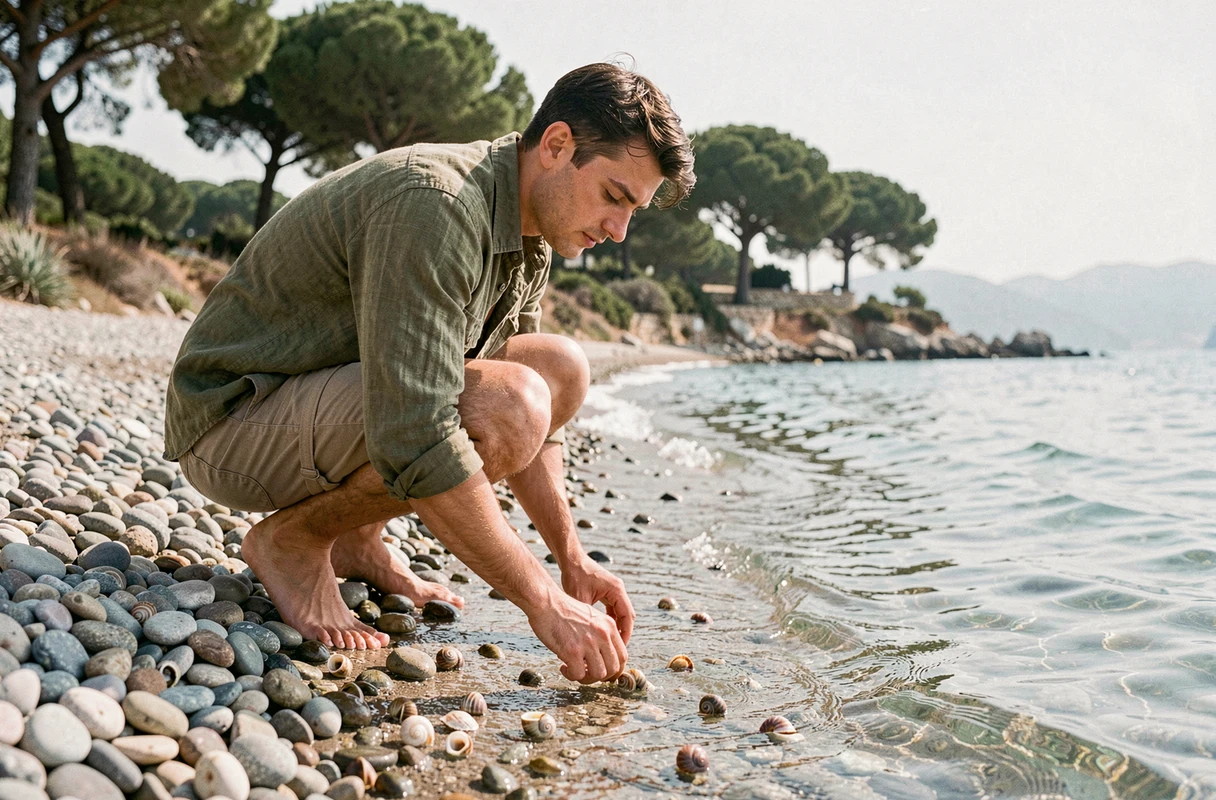
The period just after rough seas remains the best search window. Storms and gusts of wind dislodge opercula from rocky bottoms, toss them in the backwash, and deposit them on the foreshore. Searching on a beach after several days of calm weather is rarely productive.
The day after a windy episode offers the best conditions, ideally in the morning before the first walkers pass by. The high tide line, this line of debris that the tide or swell deposits highest on the sand, concentrates opercula mixed with shell fragments, seaweed, and driftwood.
What distinguishes a true eye of Saint Lucia from a simple shell fragment
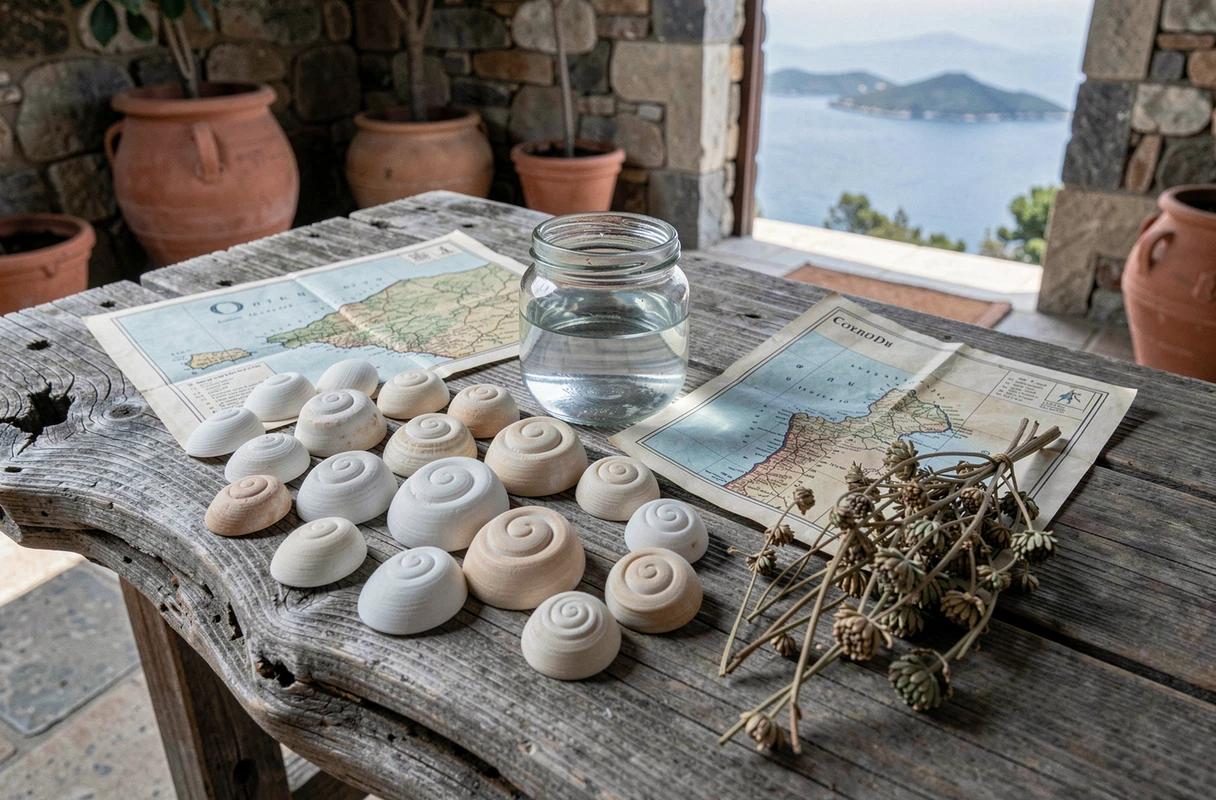
The operculum of Bolma rugosa features a rough brown domed side and a smooth, flat side with a characteristic spiral ranging from white to orange-brown. It is this polished side that gives it its popular name. Shell fragments from turbo snails or limpets can be confusing, but they never display this regular spiral on such a smooth surface.
The most sought-after pieces measure between one and three centimeters in diameter. Smaller opercula are common but less valued for Corsican handmade jewelry.
Eye of Saint Lucia and marine environment: limits of overly intensive collection
Bolma rugosa is not a threatened species on a Mediterranean scale, but the available data do not allow for assessing the local impact of massive collection of opercula on Corsican populations. The operculum washed up on the beach is part of the calcium recycling cycle in the coastal ecosystem. It nourishes other organisms, stabilizes the substrate, and contributes to the chemistry of the sand.
A reasoned collection, limited to a few pieces per outing, likely has no measurable effect. In contrast, reports of collecting entire bags, sometimes intended for resale, raise a different question. No specific study on the Corsican coastline quantifies this threshold.
Bringing back one or two opercula as a souvenir is a harmless gesture. Systematically raking the high tide line over several hundred meters turns this gesture into extraction. The difference is easy to apply, even without a precise regulatory framework.