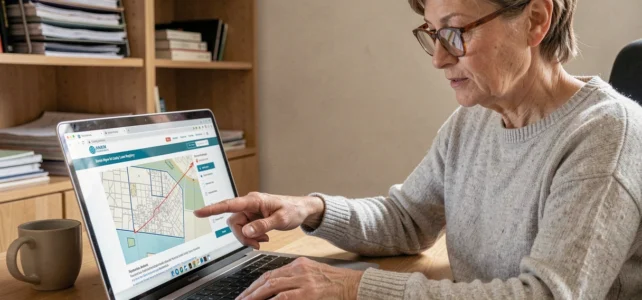
You spot a vacant lot next to your home, or a buildable plot that interests you. The natural reflex: go to the online land registry. However, the cadastral plan does not provide the owner’s name. Confusion is common, and it wastes time. Finding the owner of a cadastral plot requires combining several steps, some of which do not go through the internet.
What the online cadastral plan really shows (and what it hides)
The website cadastre.gouv.fr provides access to the plan sheets of all French municipalities. You will find the division into sections and plots, the footprint of buildings, the layout of roads and waterways.
You will not find the owner’s name on this plan. The cadastral plan has a fiscal value: it serves as the basis for calculating property tax, not for identifying individuals. The owners’ files are not open data.
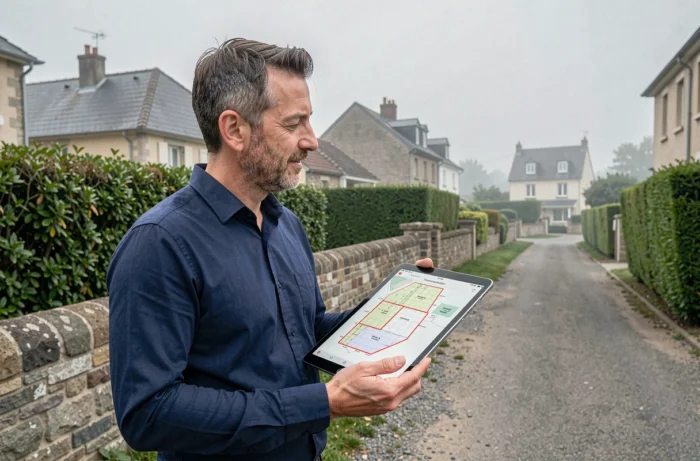
This is a point that many individuals discover after spending several minutes clicking on plots. The plan gives you the cadastral reference (section + plot number), and it is this reference that will be useful for the next steps. Note it down: it is the key to all subsequent procedures.
Knowing how to consult the cadastral plan online is therefore not limited to opening a map, but involves understanding what information each service actually provides.
Cadastral matrix and property record: the free option at the town hall
The cadastral matrix is the written document that complements the plan. It summarizes, municipality by municipality, all the plots and built properties linked to the same owner. This is where the name appears.
You have the right to request a cadastral matrix extract for any plot. The service is accessible to anyone, without needing to justify a specific reason.
How to obtain this extract
- At the town hall, at the urban planning service desk or the secretariat. Bring the cadastral reference (section and number). The response is often immediate in small municipalities.
- At the property tax center (formerly the tax office) that serves the municipality. You can go there or send a letter.
- By mail or online form to the personal tax service. The site impots.gouv.fr allows you to contact the relevant service via secure messaging.
The issuance is free in most cases. You will then receive a property record that indicates the owner’s name, the nature of the property, its size, and its cadastral rental value.
Property publicity service: when the cadastre is not enough
The cadastral matrix reflects the fiscal situation. It may be out of sync with the legal reality, especially after a recent sale or an unregistered succession. Are you looking for legal certainty about the owner’s identity? You need to contact the Property Publicity Service (SPF).
The SPF (formerly the Land Registry) keeps a history of all real estate transactions: sales, donations, successions, mortgages. Only the SPF provides a complete mortgage statement, with the chain of successive owners.
Procedure and cost
The request is made via a form (Cerfa) sent to the relevant SPF, that of the location of the property. The search is chargeable. The fee depends on the type of information requested.
This procedure is more cumbersome than a visit to the town hall. It is justified when you are preparing for a purchase, suspect a land dispute, or when the cadastral matrix provides information that seems outdated.
Occupancy data on impots.gouv.fr: a recent addition
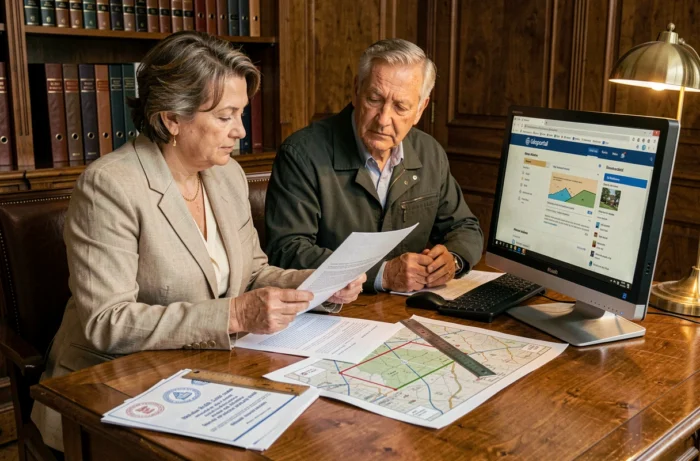
Since the implementation of the “Real Estate” service on impots.gouv.fr, owners must declare changes in the occupancy of their homes. Primary residence, secondary residence, rental, vacancy: each situation must be reported, along with the identity of the occupants.
This obligation, renewed and clarified in recent years, creates a more dynamic occupancy database than the cadastral matrix alone. For the administration, it allows distinguishing the registered owner in the property file from the person who actually occupies the property.
You do not have access to this database as an individual to consult others’ data. However, it improves the overall reliability of the information held by the tax services. When you request a matrix extract, the data transmitted to you takes into account these recent declarations.
Open data platforms and third-party tools: what they concretely provide
Several recent services aggregate the cadastre with other open datasets: real estate transactions (DVF file – Demandes de Valeurs Foncières), urban planning rules (PLU), natural risk data.
Portals like cadastre.data.gouv.fr or France Cadastre allow you to visualize plots, cross-reference geographical information, and sometimes find the price of the last sale on a given plot via DVF. None of these services disclose the name of the owner of a plot belonging to a natural person.
A notable exception: for legal entities (SCI, companies, local authorities), some professional platforms allow identifying the owner by cross-referencing cadastral data and public company registers. GéofoncierEXPERT, for example, provides access to legal entity owners on its plot sheets.
For an individual looking for the natural person owner of a plot, the administrative route (town hall or SPF) remains the only legal and reliable option.
The online cadastre is a starting point, not an answer. It gives you the plot reference, its location, its area. The owner’s name, however, can be obtained at the town hall for free or at the Property Publicity Service for a complete history. Starting by noting the exact cadastral reference is the only step that conditions all the others.