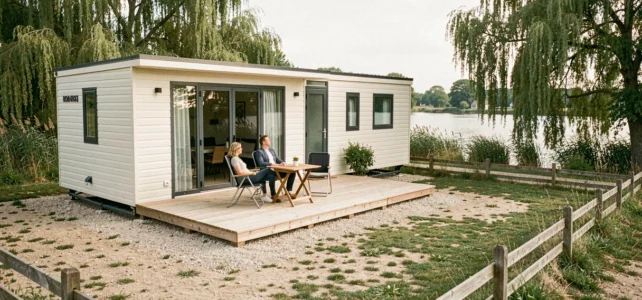
A plot with a mobile home in Vendée near the water refers to a parcel located in a campsite or a residential leisure park (PRL), on which a mobile leisure residence is installed, close to a lake, river, or the coastline. The owner holds the mobile home, but the land remains subject to a site contract or, in some PRLs, a separate lease. This legal distinction conditions everything else: taxation, duration of occupation, resale.
Legal status of the land and the mobile home in Vendée
A mobile home is not real estate. The Urban Planning Code classifies it as a mobile leisure residence, meaning it retains its means of mobility (wheels, chassis) even once placed on its parcel. This qualification has a direct consequence: no property tax on the mobile home itself, unlike a traditional secondary residence.
The site, on the other hand, is subject to an annual rental contract in a campsite, or a lease that can last several years in a PRL. The nuance matters. In a campsite, the manager may not renew the site contract, forcing the owner to move their mobile home. In a PRL, the contractual framework generally offers more stability.
The ALUR law has clarified certain rules regarding lightweight housing and mobile residences, but it does not allow for the installation of a mobile home on non-buildable private land for year-round living. Considering the purchase of land with a mobile home in Vendée therefore requires checking the type of accommodation structure and the exact nature of the lease before signing.
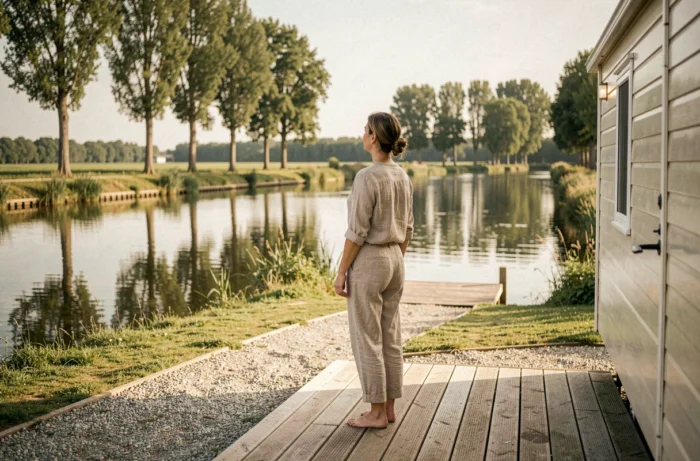
Proximity to water in Vendée: what it changes concretely
Vendée has a dense hydrographic network: marshes, lakes (including Lake Jaunay or Lake Grand-Lieu nearby), rivers like the Vie or the Lay, and of course an extensive coastline. Choosing a location near the water is not just about visual comfort. It affects the rental value of the mobile home if you plan to sublet it for part of the year.
A mobile home located just minutes from a body of water or direct access to the sea generates a higher occupancy rate in the summer season than a location set back inland. Holidaymakers searching for a campsite in Vendée heavily filter by proximity to the beach or a lake.
Coastal climate and mobile home adaptation
The proximity to water also implies increased exposure to the elements. Vendée campsites face increasingly marked climatic episodes, with heat waves documented by Ouest-France in 2026 pushing managers to adapt their infrastructures. The demand for air conditioning in mobile homes has significantly increased in recent years.
Salt air accelerates the corrosion of the chassis and metal components. A mobile home installed less than a kilometer from the coastline requires more frequent maintenance than a model placed inland. Cladding, seals, roofing: these areas must be inspected annually to avoid accelerated depreciation upon resale.
Fire safety: an underestimated criterion in site selection
In July 2026, more than 2,700 people were evacuated from two campsites in Vendée after fires, according to France 3 Pays de la Loire. These events remind us that the choice of the plot includes an assessment of fire risk, particularly for sites bordered by dry vegetation or located at the edge of wooded areas.
Before buying, ask specific questions to the campsite or PRL manager:
- Does the site have compliant fire hydrants and a recently tested evacuation plan?
- What is the minimum distance between two mobile homes on parcels close to the water?
- Are regular brush clearing operations carried out on adjacent wooded parcels?
A lakeside location, for example, presents a lower risk of fire spread than a location surrounded by maritime pines. This parameter also affects the insurance premium of the mobile home.
Site contract and annual fees: items to check
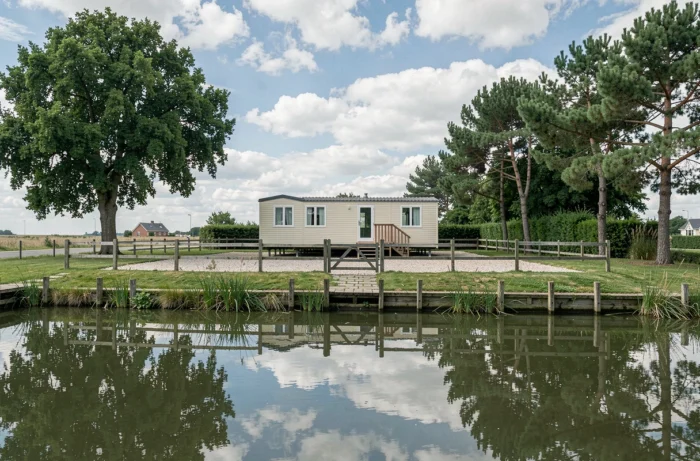
The purchase price of the mobile home represents only part of the budget. The annual rent for the plot constitutes the heaviest recurring expense, and it varies greatly depending on the location. A site by the river or facing a lake costs more than a standard plot in the center of the campsite.
Here are the recurring fees to include in the calculation:
- The site rent, charged annually, which covers access to the land and common areas
- Connection charges (water, electricity, sanitation), sometimes included, sometimes billed separately
- Insurance for the mobile home, mandatory, the amount of which depends on the location and value of the property
- Regular maintenance (terrace, cladding, roofing, potential air conditioning) which increases in coastal areas
Some campsites also require the replacement of the mobile home after a certain period, usually between fifteen and twenty years. This clause, often buried in the contract, can turn an apparently profitable purchase into an unforeseen burden.
Subletting and profitability
Most Vendée campsites allow the subletting of the mobile home during the weeks when the owner is absent. The manager takes a commission on the rental income. Profitability directly depends on the summer occupancy rate, which is correlated with the location near the water and the campsite’s amenities (pool, direct beach access, activities).
If you sublet your mobile home, the regulations on furnished tourism apply. Since recent legislative changes, registration at the town hall may be required depending on the municipality. Check with the town hall of the municipality where the mobile home is located before putting it up for seasonal rental.
Land in PRL or site in a campsite: two distinct logics
A PRL (residential leisure park) and a classified campsite do not operate in the same way. In a PRL, the owner of the mobile home may sometimes acquire the plot itself, which radically changes the situation in terms of land security. In a campsite, the land remains the property of the manager.
In Vendée, both formulas coexist. PRLs located near a lake or river offer a more permanent setting, but the entry ticket is higher. Campsites, which are more numerous, offer sites at more accessible annual rates, with the trade-off being less long-term visibility.
The choice between PRL and campsite depends on your usage horizon. For family use over ten to fifteen years, a PRL with a long lease secures the investment. For more flexible use, with the possibility of quick resale, a well-located campsite by the sea may suffice, provided you read every clause of the site contract before signing.