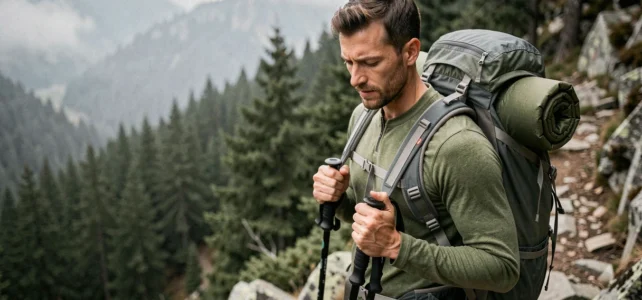
Outdoor equipment consists of three interdependent systems: protection against the elements, carrying, and sleeping. Each link conditions the safety and comfort of the outing, whether it’s a day hike or a multi-night bivouac. Before packing a backpack, the most useful question remains that of the weight carried in relation to the actual duration of the activity.
Bivouac and stove regulations: what equipment lists overlook
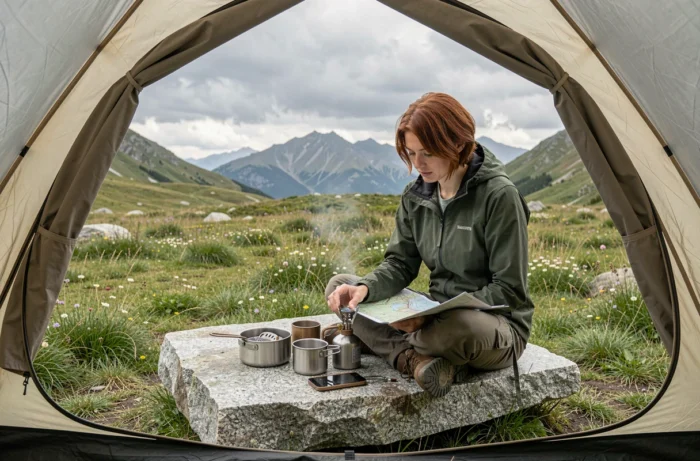
Most equipment guides present the stove as an essential item. In practice, a stove can become illegal depending on the time of year and the mountain range. Since the summer of 2026, several mountain prefectures, particularly in Haute-Garonne and the Pyrenees, have issued decrees prohibiting campfires, barbecues, and stoves in forested areas during red alert episodes of forest weather.
These prohibitions apply even to a discreet bivouac without an open fire. Offenders face fines. Checking the current prefectural decrees is therefore part of the preparation, just like choosing the equipment.
Regarding accommodation, the French Urban Planning Code states that camping is freely practiced outside the boundaries of roads and public paths, provided that the landowner’s permission is obtained. The term bivouac has no autonomous legal existence: the distinction between bivouac and wild camping falls under local regulations, particularly those of national parks and nature reserves. It is necessary to consult the regulations specific to each protected area before pitching a tent.
To choose equipment suitable for these constraints, the equipment offered by L’Esprit Nature covers a wide range of configurations, from lightweight trekking to base camp.
Three-layer clothing system for hiking
The principle of layered clothing structures all clothing choices in the outdoors. Each layer serves a specific function, and removing or adding one allows for adaptation to temperature variations without changing outfits.
- The base layer (technical underwear) wicks away sweat. Synthetic fibers or merino wool dry quickly and limit irritation over long distances.
- The mid-layer (fleece, softshell) retains body heat. Its thickness is chosen based on altitude and season.
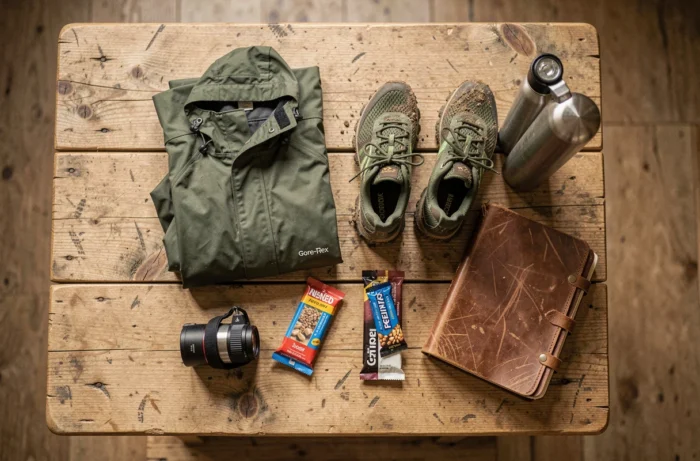
- The outer layer (windproof or waterproof jacket) protects against wind, rain, and snow. A breathable membrane prevents a sauna effect during exertion.
In summer, the mid-layer may sometimes be reduced to a simple lightweight vest. At altitude or in unstable weather, it becomes the most utilized piece. The common point of all layers: prioritize materials that retain their insulating properties even when wet.
Trekking shoes: selection criteria beyond size
Choosing a half size larger than your usual size remains common advice, and for good reason: feet swell during exertion, especially when descending. A shoe that is too tight can cause blisters and black toenails within hours.
The choice of model depends on the terrain. A flat forest path does not require the same sole rigidity as a rocky high-altitude trail. A high-top shoe protects the ankle on unstable terrain, but adds weight to the stride on a rolling path. For a day hike on a marked trail, low-cut shoes with a grippy sole are generally sufficient.
Breaking in shoes before departure is often underestimated. Wearing new shoes on several short outings allows the leather or synthetic material to mold to the foot. Starting directly on a multi-day trek with unbroken-in shoes significantly increases the risk of injury.
Backpack and sleeping gear: balancing the weight carried
The backpack serves as the physical link between the hiker and their gear. Its volume is chosen based on the duration of the outing: a bag of twenty to thirty liters is suitable for a day, while a trek with bivouac requires a significantly larger volume to accommodate a tent, sleeping bag, and food.
The current trend in the trekking industry pushes manufacturers to reduce the weight of each component. This quest for saved grams has a concrete effect: a lighter sleeping bag allows for a reduction in the volume of the backpack, which decreases fatigue on long stages. The trade-off is often a higher price for a marginal gain in thermal comfort.
Comfort temperature of the sleeping bag
Sleeping bags generally display three temperatures: comfort, limit, and extreme. The comfort temperature corresponds to the conditions in which an average sleeper has a decent night. Choosing based on the limit temperature exposes one to the cold as soon as conditions deteriorate slightly.
Down offers a better warmth-to-weight ratio than synthetic, but it loses its insulating properties when wet. In humid environments or for outings where drying is uncertain, synthetic filling remains more reliable.
Water and first aid: the two areas not to underestimate
Dehydration remains the most common cause of discomfort while hiking. Carrying a filtration or purification system allows for replenishing water reserves along the way, without relying solely on the volume transported at the start. Tablets, pump filters, or filtered water bottles serve different uses depending on the water flow available on the route.
Regarding first aid, a first aid kit tailored to the duration and isolation of the route is more useful than a standardized kit. Band-aids, antiseptic, compression bandage, and emergency blanket form a minimal foundation. For outings in isolated areas, adding a splint and a whistle changes the game in case of an incident.
Preparing for an outing in the outdoors involves as much verifying regulatory constraints as choosing the right equipment. A well-thought-out bag does not compensate for an ignored prefectural decree, and the best equipment remains that which corresponds to the terrain, the season, and the actual duration of the outing.