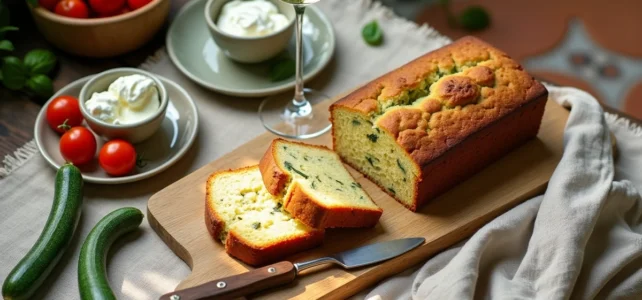
Zucchini cake poses a simple question to which the usual answers often limit themselves to “a green salad” or “a glass of rosé.” However, the subject deserves more thought, because this savory cake, depending on whether it contains goat cheese, feta, olives, or sun-dried tomatoes, does not call for the same accompaniments at all.
Building a meal around this dish requires taking into account its moist texture, richness in cheese, and density. The goal is not to decorate the plate, but to balance a meal that stands strong in terms of taste and nutrition.
Texture and filling of the cake: the starting point for any pairing
Before choosing an accompaniment, one must look at what is in the cake. A zucchini-goat cheese-mint cake is nothing like a zucchini-feta-olive cake, neither in texture nor in saltiness. The filling guides everything else.
A fresh goat cheese cake offers a melting, slightly tangy batter. It pairs well with a bright accompaniment, such as raw tomatoes seasoned with olive oil and basil. In contrast, a feta cake, which is already saltier and crumblier, benefits from being served with something sweet and crunchy, such as grated carrots with cumin or a cucumber salad with yogurt.
The question of what to eat with a zucchini cake therefore depends first on the recipe itself, not on a generic list applicable to all savory cakes.
Composed salads and vegetables: moving beyond the “mesclun” reflex
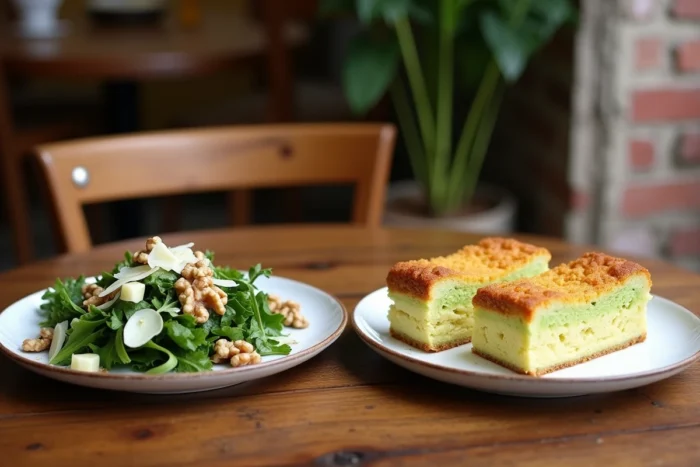
A green salad as an accompaniment to a savory cake is a somewhat lazy classic. It brings neither texture contrast nor significant nutritional complement. Composed salads, on the other hand, change the game.
Playing with contrasts through crunch
A zucchini cake is inherently moist, sometimes even very soft. The accompaniment should provide what the cake lacks: crunch, acidity, freshness.
- A radish and fennel salad, dressed with lemon juice, offers a crisp bite that contrasts with the cake’s batter.
- Raw zucchini ribbons, marinated in olive oil and balsamic vinegar, create a vegetal echo without redundant texture.
- A mix of cherry tomatoes, black olives, and capers works well with a goat cheese cake, provided the salad is not salted (the cake takes care of that).
Roasted vegetables for a complete meal
In autumn or winter, cold salad loses its appeal. Roasted vegetables (bell peppers, eggplants, red onions) provide concentrated flavors that support the cake without overwhelming it. Roasted vegetables complement the cake better than a warm salad because they add caramelization where the cake remains soft.
Plant proteins and grains: building a real meal
The zucchini cake, even generous in cheese, remains a carbohydrate-dominant dish. To make it the centerpiece of a balanced meal, adding a source of protein changes the structure of the plate.
In recent years, combinations of zucchini with legumes or whole grains have multiplied in French flexitarian cuisine. Quinoa, chickpeas, and bulgur are among the most natural companions for zucchini, according to several recipe and nutrition sites.
Quinoa salad with herbs
A quinoa salad with diced raw zucchini, dried apricots, and fresh mint creates a complete accompaniment. Quinoa provides protein and structure, while the fresh herbs evoke the cake’s aromas without duplicating them. This type of plate works well for a picnic or as a starter before the cake.
Hummus or chickpea spread
Hummus served alongside the cake transforms an appetizer into a light meal. The creamy texture of the hummus compensates for the cake’s compactness, and the sesame (tahini) adds an aromatic dimension absent from the main dish. For an appetizer, cutting the cake into bites and serving the hummus as a dip works better than a plated service.
Sauces and condiments: the accompaniments we forget
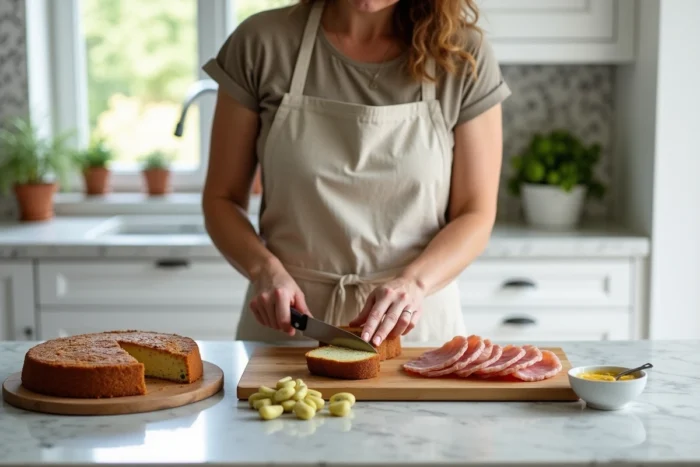
Competitors rarely talk about sauces, even though they radically change the experience. A zucchini cake served alone can seem a bit dry in the mouth, even when the recipe is successful. The sauce corrects that.
Herbed cottage cheese remains the simplest and most effective pairing. Chives, dill, a hint of garlic, salt, pepper. The creamy freshness of the cottage cheese lightens the cake’s density and adds a dipping aspect that everyone enjoys, especially in appetizer format.
A fresh tomato coulis (raw blended tomatoes with basil and olive oil) adds acidity and color. This is not a cooked tomato sauce; it is a quick raw condiment that does not mask the cake’s flavor.
For goat cheese versions, a honey and thyme vinaigrette drizzled over the accompanying salad creates a flavor link with the cheese in the cake. The sauce should extend the flavors of the cake, not compete with them.
Zucchini cake as an appetizer or main dish: two different logics
The context of the meal changes the suitable accompaniments. As an appetizer, the cake is cut into small cubes or thin slices. Finger foods are needed: carrot sticks, cherry tomatoes, olives, various dips.
- In appetizer format, plan for at least two dips (herbed cottage cheese and tapenade, for example) to vary the bites.
- As a main dish, pair the cake with a grain salad and roasted vegetables to achieve satiety.
- At a picnic, the cake travels better than most hot dishes, but you need to choose accompaniments that won’t spill: tabbouleh, lentil salad, whole tomatoes.
This distinction between appetizer and meal is rarely addressed in accompaniment guides, yet it conditions everything: the cutting format, the choice of complementary textures, the amount to plan per person.
A well-accompanied zucchini cake doesn’t need much. A fresh sauce, a crunchy vegetable, a source of protein if the meal requires it. The trap would be to overdo it and drown a dish whose simplicity is precisely its strength.