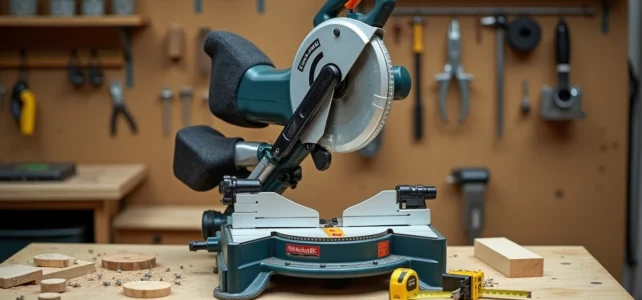
A miter saw equipped with a 2000 W motor ranks among the high-end machines intended for individuals and occasional craftsmen. This level of power allows for tackling dense woods (oak, beech) and certain aluminum profiles without the motor struggling, provided that the blade and the guiding system keep up.
The Tacklife PMS03A, the flagship model of the Tacklife range in this category, deserves a thorough technical review to determine whether the advertised power translates into actual cutting quality.
Quality of the manual and traceability: a criterion often overlooked in tests
Online comparisons focus on power, blade diameter, and angle capabilities. One aspect rarely addressed is the technical documentation provided with the machine. The European regulatory framework strengthens documentation requirements for power tools: comprehensive user manuals, maintenance procedures, information on residual risks, in both paper and digital formats.
On this point, the Tacklife PMS03A has a limitation. Several users report a poorly translated manual, with safety instructions that are sometimes unclear. For a machine of this power, having precise instructions on adjusting the protective cover or replacing the blade remains a safety prerequisite.
The Tacklife 2000W miter saw has also been affected by the brand’s commercial repositioning. Tacklife has gradually reduced its presence on European marketplaces since 2021-2022, leading to a noticeable decrease in availability in France. Finding spare parts or a responsive after-sales service can now be problematic.

Cutting capacity and miter adjustment on the Tacklife PMS03A
The miter cutting system is the functional core of this machine. The head pivots to make angled cuts, and the radial (sliding) function allows for an increased cutting width compared to a fixed miter saw.
Miter and bevel: two distinct adjustments
The confusion between miter cuts and bevel cuts remains common. The miter corresponds to the horizontal rotation of the blade, used for example to assemble frames or install baseboards at an angle. The bevel, on the other hand, tilts the cutting head on a vertical plane, allowing for chamfers.
The PMS03A offers a miter adjustment with predefined positions (notches at the most common angles) and an adjustable bevel. The precision of these adjustments determines the quality of the joints. On this model, the angle stops show noticeable mechanical play after a few months of regular use.
Cutting width and depth
The radial function (sliding arm) extends the cutting capacity to pieces wider than the blade diameter would allow. For standard baseboards, paneling, or battens, the capacity is more than sufficient. However, for edge boards or structural pieces, the stroke of the sliding arm limits possibilities on the widest sections.
- Straight cuts at 90° in softwood are executed quickly and cleanly thanks to the powerful motor.
- Compound miter cuts (miter + bevel simultaneously) require meticulous clamping of the piece, as the original fastening system lacks rigidity.
- Cutting hard woods (oak, ash) remains possible but produces more splintering on the underside if the original blade is not replaced with a fine-toothed model.
Original blade and replacement: a point not to be overlooked
The blade supplied with the Tacklife PMS03A is a versatile carbide blade. This type of blade is suitable for initial general cutting tasks, but its limitations quickly become apparent on finishes. Investing in a fine-toothed replacement blade significantly improves precision and reduces splintering.
The blade diameter and bore must match the machine’s specifications exactly. The market offers compatible blades from several third-party manufacturers. This is a moderate investment that transforms the cutting results, particularly on varnished or melamine woods where splintering at the blade exit remains the main flaw.
Stability, dust extraction, and ergonomics at the workstation
A miter saw of this power generates a significant amount of sawdust. The PMS03A comes with a dust collection bag, but its effectiveness is limited: a significant portion of the dust escapes during quick cuts. Connecting a workshop vacuum via the designated nozzle greatly improves comfort and visibility of the cutting line.
The stability of the machine on its support determines the repeatability of cuts. The original base is sufficient for occasional use on a workbench, but mounting on a dedicated support (table or wheeled cart) with bolted fixation provides superior rigidity. Without fixation, the vibrations of the motor at full load can slightly shift the piece during long cuts.
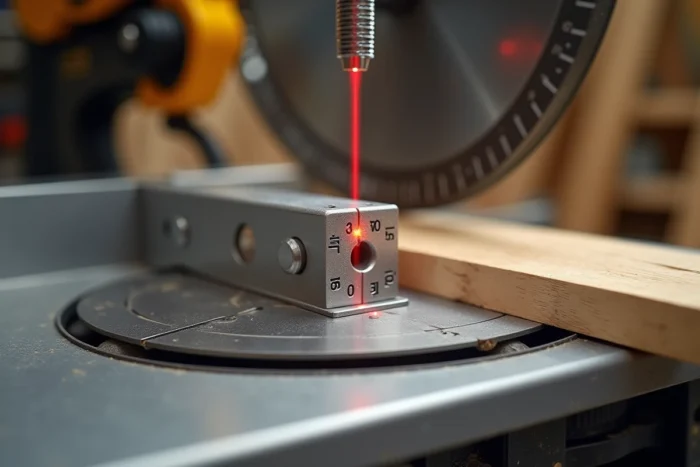
The integrated laser lighting, intended to mark the cutting line, works well in a poorly lit workshop. In bright light or outdoors, its visibility decreases significantly. A pencil line drawn beforehand remains the most reliable method to ensure precision.
Availability and alternatives after Tacklife’s partial withdrawal
The gradual withdrawal of Tacklife from European distribution channels has led to an increase in sales of equivalent models from Einhell, Evolution, and other brands sold in DIY superstores. For a buyer considering this machine today, the question of the availability of consumables (blades, motor brushes, guiding parts) should be raised before purchase.
A radial miter saw represents an investment over several years. The sustainability of access to spare parts weighs as heavily as the technical sheet in the final choice. On this criterion, brands with a stable distribution network in France offer a peace of mind that the Tacklife PMS03A no longer guarantees with the same assurance as at its launch.