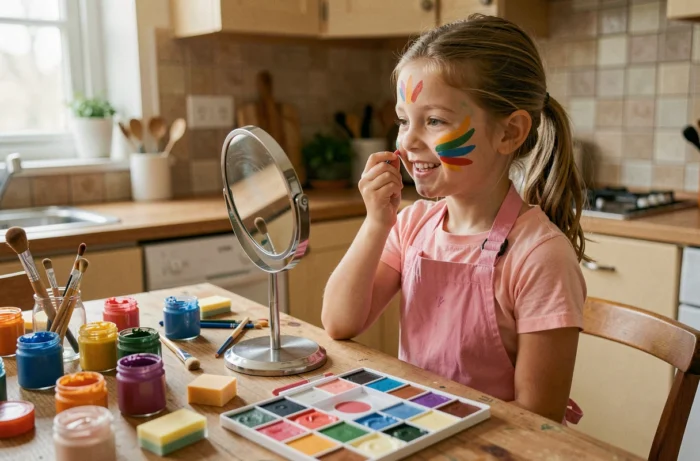
Organizing a children’s makeup workshop at home requires gathering products and materials that meet specific requirements. Children’s skin is thinner than that of adults, and a product labeled “non-toxic” in a craft store is not necessarily formulated for skin use. Before bringing out the brushes, the choice of materials determines both the safety of the workshop and the enjoyment of the participants.
Skin cosmetics or craft paint: a distinction to verify before purchase
The first instinct is to read the packaging. A cosmetic product intended for the skin displays an ingredient list compliant with European cosmetic regulations, with a clearly indicated intended use (face, body). Finger paints sold in stationery or craft sections, even washable ones, are not designed to be applied to the face.
Regular markers and DIY pigments fall into the same category: their composition may contain irritating substances for sensitive skin. For a children’s makeup workshop at home, it is essential to turn to ranges explicitly formulated for the skin, ideally dermatologically tested.
Finding the essentials at Moon Kidsstore helps navigate the references suitable for this type of activity.
Face painting professionals generally advise against makeup for children under three years old. Their skin is more reactive, and most artistic paints are not specifically formulated for this age group. It is better to plan an alternative activity for the little ones (stickers, temporary water tattoos).
Application materials: brushes, sponges, and hygiene rules
The application materials are often an underestimated aspect. Having good products is not enough if the application tools transmit impurities from one child to another.
Individual sponges and brushes cleaned between each child
Each child must have their own sponge. Shared makeup sponges are a vector for direct contamination, especially when the skin has micro-lesions that are invisible. Providing a sufficient number of disposable or washable sponges is the simplest and most effective precaution.
Brushes can be reused as long as they are cleaned between two children. A cosmetic brush cleaner spray or warm soapy water will do the trick. Washing or disinfecting hands between applications completes the setup.
What to gather before the workshop
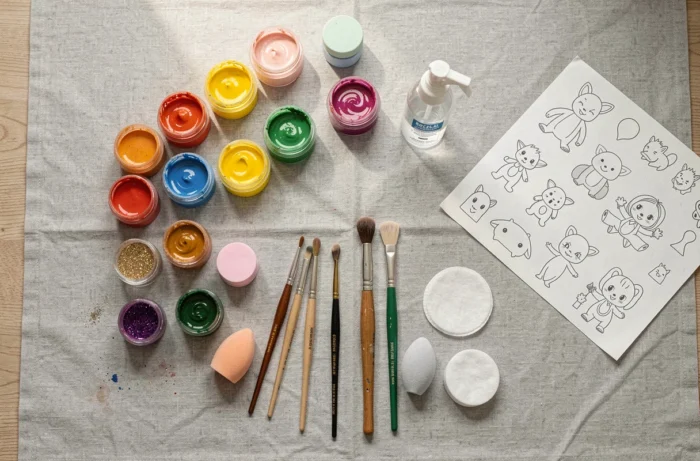
- Flat and round brushes of various sizes, suitable for small areas of the face (eye contours, cheeks, forehead). Very fine art brushes allow for detailing like mustaches or butterfly patterns.
- A set of individual sponges (one per child, plus a few spare units) for applying bases and color backgrounds.
- Cups of clean water to rinse brushes between colors, regularly refreshed.
- Paper towels or soft wipes to correct smudges and dry the materials.
- A mirror to place on the table, so each child can see the result.
Color palette and makeup formats suitable for children
Children’s makeup products come in several formats. The choice of format influences the speed of the workshop and the quality of the result.
Water-based paints in palettes remain the most common format for a home workshop. They activate with a wet brush, dry quickly, and can be removed with warm water. Their texture allows for layering without the color smudging.
Fat makeup crayons are suitable for contours and precise lines. They are easier for a beginner adult to handle, but their finish is limited for solid color applications. Combining crayons and palettes offers the best versatility.
Avoid non-cosmetic glitter: craft glitter, often made of fine plastic, can irritate the eyes or skin. If the workshop plans for sparkling effects, use only cosmetic-grade glitter, which is finer and formulated for skin contact.
Workshop safety: skin reactions and precautions to anticipate
A children’s makeup workshop at home is not a medical setting, but some precautions can reduce risks.
Exclude any child with irritated, damaged skin or active eczema. Applying a product, even one formulated for the skin, on a damaged area increases the risk of reaction. Offering these children a different role (choosing colors, drawing the model on paper) avoids frustration without compromising their comfort.
Monitor for any reactions during the activity: swelling, spreading redness, hives, or respiratory discomfort necessitate immediate cessation and removal of the product according to its instructions. A significant reaction warrants prompt medical advice.
- Conduct a discreet test on the wrist or behind the ear a few minutes before applying to the face, especially if the child has a known allergic background.
- Keep a damp cloth and mild soap handy to quickly remove makeup if needed.
- Ask parents in advance if their child has any identified skin allergies.
Setting up the space and running the makeup workshop
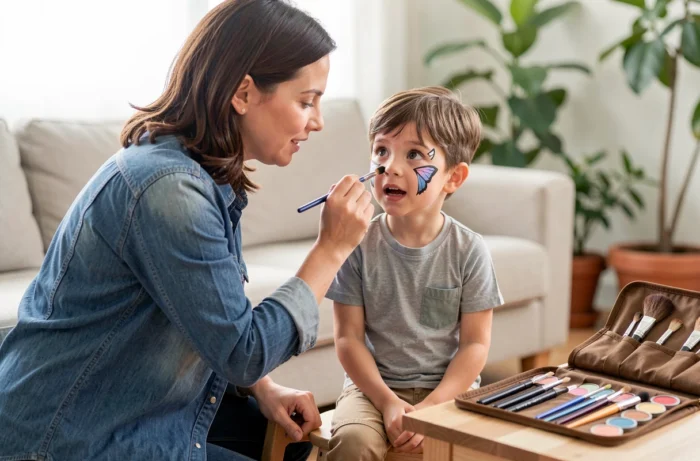
The setup of the workstation determines the smoothness of the workshop. A table covered with a plastic tablecloth, two chairs facing each other (one for the child, one for the adult doing the makeup), and sufficient lighting are the minimum requirements.
Preparing printed models on paper helps children choose quickly and reduces discussion time. Butterfly, tiger, unicorn, superhero: three to five models are sufficient for a home workshop. Too many choices slow down the line and complicate the makeup artist’s task.
Planning a separate makeup removal station, with soft wipes and a mirror, allows children to clean up at the end of the party without cluttering the makeup table. This logistical detail saves time and keeps the space clean.
The choice of materials – verified cosmetic products, individual sponges, water palette, cosmetic-grade glitter – lays the foundation for a safe workshop. The rest depends on preparation: ready models, clear space, clear hygiene instructions. A well-equipped workshop with four basic colors and clean materials yields better results than a table overloaded with unsuitable products.