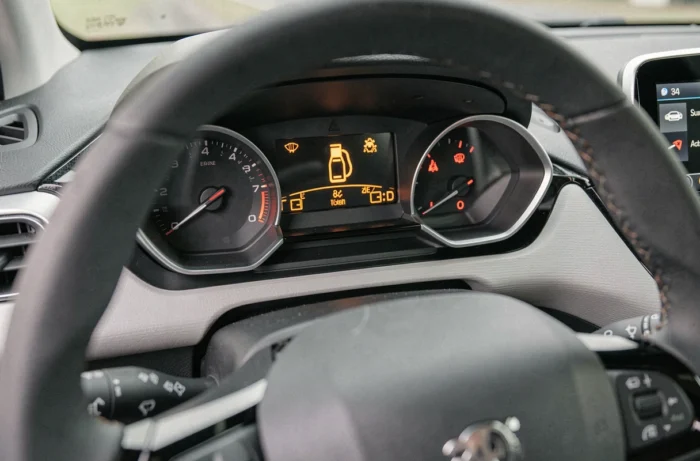
On the Peugeot 208, the dashboard displays several dozen warning symbols. Some indicate normal operation, while others require an immediate stop of the vehicle. The difference between these two categories relies on a precise coding system that Peugeot applies across its entire range, both thermal and electric.
Peugeot e-208 Warning Lights: Alerts Not Found in Thermal Versions
The online content mainly addresses the warning lights common to petrol (PureTech) and diesel (BlueHDi) engines. The electric version e-208 introduces specific indicators related to the high-voltage battery and charging system, which replace several classic alerts such as engine temperature or fuel management.
A flashing power socket symbol indicates a charging incident: cable, terminal, or onboard charger issue. This warning does not exist on thermal versions.
A turtle pictogram (reduced power) appears when the battery range becomes very low or when the system limits the available power. In this case, reaching a charging station quickly becomes a priority. These alerts are linked to the new electrical architecture of the restyled e-208 (battery of 50 to 54 kWh) and do not appear in the manuals of models prior to 2023.
To delve deeper into the meaning of the Peugeot 208 dashboard warning lights according to each engine type, the technical sheets by version allow for distinguishing common alerts from those specific to electric vehicles.
Comparison Table of Warning Lights by Color and Urgency Level
The color code used by Peugeot on the 208 follows a logic shared by most European manufacturers. Each color corresponds to a level of severity and dictates the driver’s reaction.
| Color | Urgency Level | Expected Reaction | Examples of Warning Lights |
|---|---|---|---|
| Red | Immediate Danger | Stop the vehicle as soon as possible, engine off | Oil pressure, engine temperature, braking system, STOP |
| Orange / Yellow | Anomaly to Check | Cautious driving to the garage, diagnosis recommended | Engine light, DPF, ESP, tire pressure |
| Green / Blue | Information | No action required | Turn signals, low beam lights, active cruise control, READY (e-208) |
This table covers the three families of warning lights. A red warning light always requires stopping the vehicle, without exception. An orange warning light allows for a short trip to a professional. A green or blue warning light simply confirms that a system is functioning.
Orange Engine Light on Peugeot 208: Common Causes and Pitfalls
The engine light (represented by a stylized engine block) is the most sought-after orange indicator by 208 owners. Its steady illumination indicates an anomaly detected by the computer, without the exact nature of the problem being visible to the naked eye.
Only an electronic diagnosis identifies the real cause of an illuminated engine light. The fault codes (OBD) can point to dozens of different sources: faulty lambda sensor, injection problem, pressure sensor, particulate filter clogging.
On PureTech engines, the engine light associated with a loss of power may signal an issue with the timing belt or oil pump. On BlueHDi engines, the clogging of the particulate filter (DPF) remains a recurring cause, especially for short urban trips that do not allow for automatic filter regeneration.
Fixed or Flashing Engine Light: The Distinction Matters
A fixed engine light signals a recorded anomaly, often without immediate danger. A flashing engine light indicates a risk of damage to the catalyst, typically related to misfires. In this case, reducing speed and consulting a garage promptly limits mechanical damage.
Critical Red Warning Lights: Oil, Braking, and Temperature
Three red warning lights concentrate the majority of emergency situations on the Peugeot 208.
- Engine Oil Pressure (symbol of an oil can): its illumination while driving means that engine lubrication is insufficient. Continuing to drive can cause engine failure within minutes. Checking the oil level after a complete stop is the first reflex, but the light may also indicate a failure of the oil pump.
- Coolant Temperature (thermometer): this red light indicates engine overheating. The most common causes are a low coolant level, a stuck thermostat, or a faulty fan.
- Braking System (circle with an exclamation point): beyond a handbrake that remains engaged, this light may signal a low brake fluid level or advanced wear of the pads. Any red brake warning light requires a check before resuming driving.
The STOP Light: A Cumulative Signal
The STOP light rarely appears alone. It usually lights up in combination with another red warning light to reinforce the alert. Its presence confirms that the situation requires an immediate stop. At startup, it lights up briefly during the system self-test, which is normal.
Preventive Maintenance and Recurring Warning Lights on the 208
Some warning lights reappear regularly after maintenance or mechanical intervention. The tire pressure warning light (TPMS) frequently reactivates after a tire change if the system reset has not been performed. On the 208, this reset is done through the digital dashboard menu.
The pollution alert light, often linked to the DPF on diesel versions, reappears if driving conditions do not allow for complete regeneration. A highway trip of several dozen kilometers is usually enough to trigger regeneration and turn off the light.
Ignoring an orange warning light for several weeks can turn a minor anomaly into an expensive breakdown. Electronic diagnosis, available at most equipped garages, remains the reliable method to precisely identify the fault code and the affected part before a simple faulty sensor leads to a cascade of malfunctions.