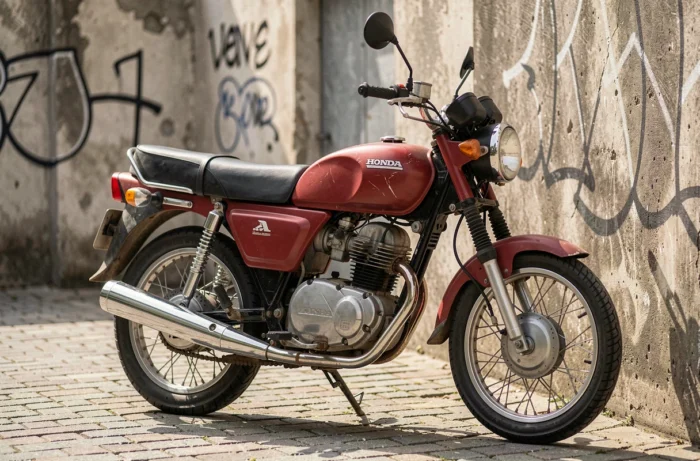
The Honda Dax 125 is a mini-bike with a 125 cc single-cylinder engine, repositioned by Honda into a modern version that retains the characteristic T-frame of the original Dax. On the second-hand market, this model is priced between 2,500 and 4,500 euros depending on mileage and overall condition. Buying second-hand requires mastering a few specific checks for this bike, beyond the usual inspections applicable to any two-wheeler.
VIN Number and HistoVec Report: Two Checks Before Moving
The VIN number stamped on the frame serves as the identity of the Dax 125. This code, cold-etched on the right side of the chassis (often near the steering column), must match character for character with field E of the registration document and the sales paperwork. Any inconsistency, even partial, may indicate a replaced frame part, an administrative error, or an attempt at tampering.
Even before the appointment, ask the seller to generate a HistoVec report. This official service allows you to check for the absence of liens, administrative opposition, or theft declarations. For a sought-after bike like the Dax 125, primarily sold between individuals, listings rarely provide a complete view of the administrative history. HistoVec fills this gap for free.
To find a used Honda Dax 125 in good condition, crossing these two steps (VIN and HistoVec) before moving helps avoid most unpleasant surprises.
Honda Dax 125 Maintenance Log: What Invoices Reveal
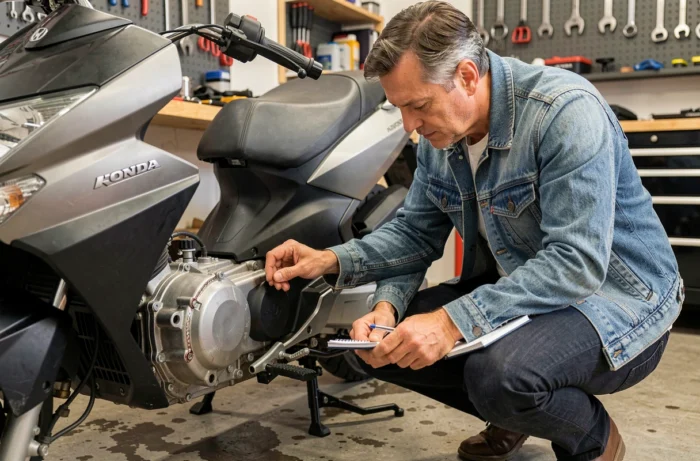
The mileage displayed on the odometer is not enough to assess the actual condition of a Dax 125. Two bikes showing similar mileage may have led very different lives depending on the regularity of mechanical follow-up.
Documents to Require from the Seller
A serious seller should present several concrete items:
- The original purchase invoice, confirming the date of first registration and the status of first or second hand
- The maintenance log stamped by a dealer or garage, with the dates and mileages of each service
- Invoices for spare parts (brake pads, chain kit, engine oil), which allow recalculating the actual frequency of maintenance
- The spare keys and, if applicable, the fob or card for the HISS anti-theft system equipped on certain versions
A documented regular maintenance is worth more than low mileage without any proof of follow-up. A Dax that has been ridden more but maintained according to Honda’s recommendations remains a better purchase than a low-mileage example whose oil has never been changed.
Oil Change and Chain: Two Reliable Indicators
On the single-cylinder Dax 125, oil change intervals are short. If the seller cannot provide any engine oil invoices, caution is warranted. The transmission chain and its tension also give a clear signal: a loose or rusty chain on a bike showing low mileage betrays neglected maintenance.
Motorcycle Technical Inspection and Honda Dax 125: The Date Trap
The mandatory technical inspection for motorized two-wheelers depends on the date of first registration, not the purchase date. A recent Dax 125 may not yet be subject to this obligation, while an older model must be accompanied by a valid technical inspection report.
During the transaction, checking this point avoids a common situation: buying a Dax thinking that the technical inspection is not required, only to discover that the date of first registration makes the document mandatory to finalize the change of registration. The seller must provide a valid technical inspection if the bike falls within the regulatory scope.

Physical Inspection of a Used Dax 125: Specific Points
Generic motorcycle buying guides cover brakes, tires, and suspensions. On the Dax 125, a few elements deserve special attention related to the design of the model itself.
The T-Frame and Its Welds
The T-frame of the Dax is a key component. Visually inspect the welds at the swingarm pivot and the steering column. Signs of grinding, welding repairs, or suspicious localized paint may indicate structural damage. A damaged frame on a Dax compromises the entire geometry of the bike.
Underseat Storage and Space
The space under the seat of the Dax 125 is very limited and does not accommodate a full-face helmet. This point is not a hidden defect, but it often surprises buyers who are discovering the bike for the first time. Check that the seat locking mechanism works properly and that the lock has not been forced.
Elements to Check On-Site
- Tire condition: regular or asymmetric wear (a sign of geometry issues)
- Functioning of front and rear brakes, with a lever and pedal test both at rest and while riding
- Tension and condition of the transmission chain, visible lubrication or lack thereof
- Battery: check connections and cold starting, without prior warming by the seller
- Complete instrumentation: speedometer, indicators, turn signals, brake light
Requesting a cold start remains the most revealing test. A pre-warmed engine masks starting difficulties, idle misfires, and abnormal mechanical noises. Arriving without warning of the exact time limits this risk.
The market for used Honda Dax 125 remains tight, with demand often exceeding available supply. This pressure pushes some buyers to rush the transaction. The checks described here take less than an hour and protect an investment that represents several thousand euros. A transparent seller will welcome these checks without reluctance, and it is precisely this attitude that distinguishes a good deal from a regrettable purchase.