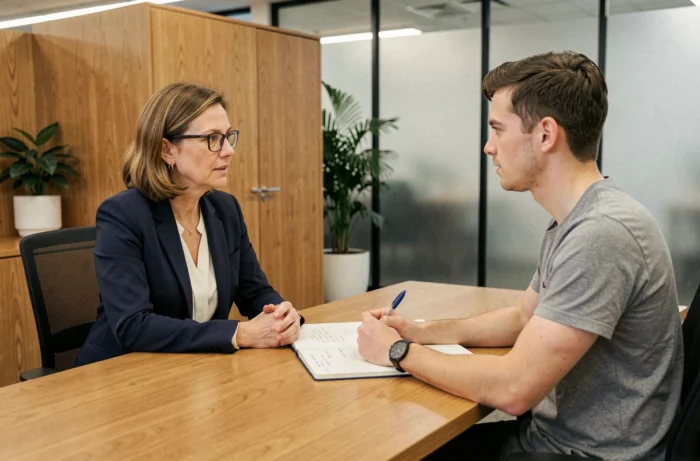
A collaborator who is stagnant is not necessarily a demotivated collaborator. Often, they simply lack a framework that allows them to demonstrate what they can do differently. Developing talent in the workplace is less about standardized programs and more about concrete mechanisms tailored to each profile. The difficulty rarely lies in the will, but in the ability to identify the right lever at the right time.
AI Skills and Legal Obligation: A New Area for Talent Development
More and more internal tools are integrating artificial intelligence, sometimes without the teams being fully aware of it. Since February 2, 2025, Article 4 of the European AI Act requires organizations using AI systems to ensure a sufficient level of AI mastery among their users.
This obligation does not only concern technical profiles. It extends to anyone who uses or supervises an AI-based tool, including in HR, sales, or administrative functions.
This regulatory framework transforms skill development in the workplace. It is no longer enough to offer a one-time training session on software. Managers must guide their collaborators towards reliable, explainable, and compliant use of these tools. In practical terms, this means mapping the AI systems used in each department, specifying who is responsible for them, and planning for human oversight at every critical stage.
For companies structuring their approach to talent development, specialized resources exist, such as https://lafabriqueatalents.fr/, which offers support focused on revealing individual potential.
The key point: upskilling in AI is becoming a compliance criterion, not just a competitive advantage. A manager who ignores this dimension exposes their organization to a real legal risk.
Employee Potential Assessment: Why Traditional Grids Are No Longer Enough

Annual evaluation grids generally measure past performance. They answer the question “what has this collaborator done?”, rarely “what could they do in a different context?”. Potential, by definition, is not yet visible in the results.
Let’s take a simple example. A person in the accounting department consistently resolves conflicts between colleagues during meetings. This relational skill does not appear on any job description, yet it indicates a mediation talent that can be leveraged in a management or project coordination role.
Identifying potential requires observing behaviors in real situations, not just quantitative indicators. A few concrete signals deserve particular attention:
- A collaborator who spontaneously takes on tasks outside their scope, especially when they involve coordination between departments
- A person who asks questions about the overall functioning of the company, beyond their direct missions
- A team member whom others naturally turn to in case of difficulty, even without a hierarchical link
The AI Act adds an additional limitation to this detection. Companies cannot use automated behavioral analysis or emotional recognition to assess the potential of their employees. Identifying talent remains a human and managerial responsibility.
Individual Development Plan: Building a Sustainable Path
Identifying a talent without offering a concrete trajectory is like starting an engine without engaging a gear. The individual development plan is the tool that connects the observation of potential to real evolution.
The difference between an effective plan and a document filed away without follow-up lies in three specific elements:
- A goal formulated in terms of skills to acquire (not in terms of a position to reach), with a realistic time horizon
- Varied actions that do not limit themselves to traditional training: cross-functional missions, mentoring, participation in a pilot project, pairing with a colleague from another department
- A regular follow-up point, ideally monthly, focused on learnings and encountered obstacles, not on the final result
A collaborator entrusted with coordinating a cross-functional project for three months learns more about management than in a two-day theoretical training. Learning through real-life situations produces lasting skills.

The manager’s role here is not to decide alone on the path. It consists of asking the right questions: what professional situations energize the collaborator? What tasks provoke boredom or frustration? These answers guide the plan much more finely than a catalog of training courses.
Engagement and Internal Mobility: What Talent Development Changes Practically
A collaborator who sees a possible progression within their company has fewer reasons to look elsewhere. Talent management, when it goes beyond mere intention, directly impacts retention and engagement.
Internal mobility is often an underutilized lever. Offering a change of position or scope does not necessarily mean promoting someone. A lateral move (changing departments at the same level) can be enough to reignite the motivation of a stagnant profile. Internal mobility costs less than external recruitment and preserves company knowledge.
Professional evolution is also not limited to hierarchical advancement. Some collaborators excel in an expert role without any desire to manage a team. Offering them a specialization path, with clear recognition (title, technical responsibility, participation in strategic decisions), values their talent without forcing them into an unsuitable mold.
Developing talent means accepting that each professional path has its own logic. The company’s role is to provide the framework, tools, and trust. The rest belongs to each collaborator, provided they are given the space to express it.