
Walking 100,000 steps is a goal that you sometimes encounter in sports challenges or multi-day hikes. But what does this number correspond to in actual distance and hours of walking? The answer depends on a few simple variables, starting with your stride and pace.
Stride Length and Actual Distance for 100,000 Steps
To estimate the distance covered, you need to start with an element that many overlook: the length of your stride. This varies depending on your height, gender, and the terrain.
A common benchmark places the average stride of an adult between 60 and 80 cm. The taller you are, the longer your stride naturally becomes. A woman of average height will tend to have a shorter stride than a tall man.
Applying these ranges to 100,000 steps gives a distance of approximately between 65 and 80 km. In practical terms, this is equivalent to the distance between two medium-sized cities or a very long stage of a hiking trail.
If you want to refine this calculation, the most reliable method is to measure your own stride. Count 10 steps on flat ground, measure the distance covered, and then divide by 10. This personal figure will replace any theoretical estimate. You can also consult a tool dedicated to converting 100,000 steps to km to get a result tailored to your profile.
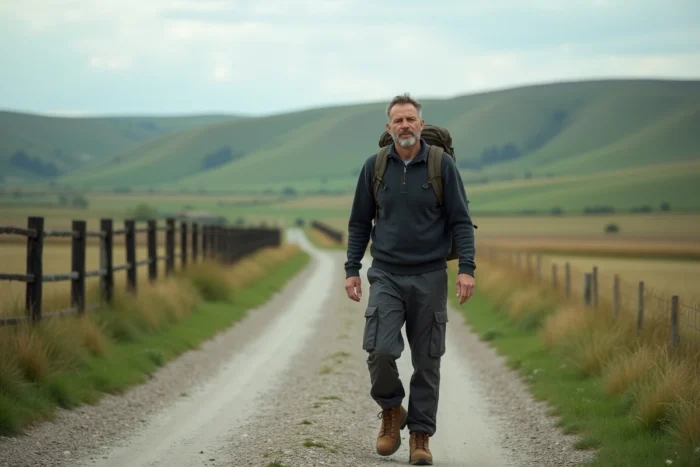
Walking Time to Reach 100,000 Steps
You now know the distance. How long does it take to cover it? Again, it all depends on your walking speed.
At a moderate pace (around 4 to 5 km/h, which corresponds to an active walk without straining), covering 65 to 80 km takes between 13 and 20 hours of actual walking, not including breaks.
This hourly volume far exceeds what most walkers can handle in a single day. To give you an idea, walking 10,000 steps generally takes between 1.5 and 2 hours. Multiply that by ten, and you understand why 100,000 steps are almost always spread over several days.
Factors Affecting Walking Time
The speed of 4 to 5 km/h corresponds to flat and even terrain. Several factors can extend the duration:
- Elevation change: a hilly or mountainous path can reduce speed by half compared to a sidewalk in the city.
- Muscle fatigue: after several hours, the stride shortens and the pace slows, even for a trained walker.
- Carried weight: a loaded backpack decreases pace and increases the necessary break times.
- Age and physical condition: a sedentary person will walk slower than a regular hiker, given the same height and terrain.
On rough terrain with a backpack, expect to lean towards the upper end of the range, or even beyond 20 cumulative hours.
Distributing 100,000 Steps Over Several Days
You may have noticed that most health recommendations revolve around 7,000 to 10,000 steps daily? At this rate, reaching 100,000 steps would take between 10 and 14 days, which corresponds to regular physical activity without exceptional effort.
For a sports challenge or intensive hike, some walkers aim for 25,000 to 30,000 steps per day. In this case, 100,000 steps can be completed in three to four days, with 5 to 7 hours of walking each day.
Summary Table by Daily Pace
| Steps per Day | Days Needed | Hours of Walking per Day (Estimate) |
|---|---|---|
| 10,000 | 10 | 1.5 to 2 |
| 15,000 | 6-7 | 2.25 to 3 |
| 25,000 | 4 | 3.75 to 5 |
| 30,000 | 3-4 | 4.5 to 6 |
These estimates assume flat terrain and a moderate speed. Adjust them to your actual situation.

Why 100,000 Steps is an Unusual Goal
The majority of content on walking stops at 10,000 or 20,000 steps. This is not a coincidence. 10,000 steps represent about 7.5 km, a volume accessible to most healthy adults on an ordinary day.
The goal of 100,000 steps belongs to a different category. It falls under physical challenge, long-distance hiking, or weekly accumulation for avid walkers. Attempting to achieve this volume in a single day exposes one to real risks: tendinitis, severe blisters, deep muscle fatigue.
An experienced walker preparing for such a challenge benefits from breaking up the effort. Alternating walking and resting, varying surfaces (asphalt, dirt, grass), and gradually increasing the step volume over several weeks reduces the risk of injury.
Adapting the Calculation to Your Physique
Your height directly influences the distance. A person who is 1.60 m tall will cover fewer kilometers for the same number of steps than a person who is 1.85 m tall. The difference can reach several kilometers over a volume of 100,000 steps.
For this reason, measuring your personal stride remains the most accurate method. Pedometers and smartwatches also offer automatic corrections based on your profile (height, weight, gender), which refines the estimate without manual calculation.
Reaching 100,000 steps remains a goal that requires preparation and realism. Whether in three days of sustained hiking or ten days of daily activity, the actual distance will be around 65 to 80 km, with a cumulative walking time of 13 to 20 hours. The most reliable approach is to calibrate these figures based on your own stride rather than generic averages.