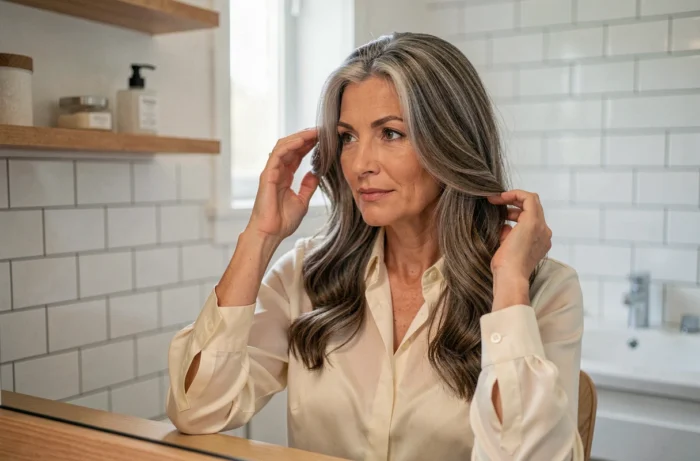
Grey blending relies on a calibrated placement of highlights to reproduce the natural dispersion of white hair within the pigmented mass. The technique does not conceal anything; it redistributes contrasts. Understanding its colorimetric mechanics allows for making the right choices, from diagnosis to maintenance protocol.
Formulation and Pigment Constraints of Grey Blending
The technical difficulty of grey blending lies in a paradox: it is necessary to lighten certain strands while respecting the integrity of white hair, which is structurally more porous and drier than pigmented hair. White hair has lost its melanin, which alters its ability to absorb toning pigments.
In the salon, we observe that toners that are too loaded with direct pigments quickly shift on white hair, resulting in a dull grayish outcome instead of the desired blend. The choice of vehicle (acid gloss vs alkaline toner) determines the longevity and transparency of the result.
A rarely discussed point concerns the new European restrictions on certain coloring molecules. Substances like HC Blue or HC Yellow are subject to limitations in Annex III of the European cosmetic regulation. This reduces the palette of cool shades available for grey blending toners and pushes formulators to work with alternative pigment blends, which are sometimes less stable over time.
We recommend exploring grey blending for men on Beauté Authentique, where the technique is adapted for shorter lengths with even tighter blending constraints.

Grey Blending on Textured Hair: Curly, Kinky, and Wavy
The majority of content on grey blending illustrates the technique on straight or slightly wavy hair. In practice, curly and kinky hair responds differently to transitional highlights. The curl creates a natural play of shadow and light that can amplify or flatten the blend, depending on the placement of the strands.
On kinky hair, porosity is often heterogeneous along the shaft. Areas of maximum curvature absorb the toner more quickly, resulting in uneven deposits if the processing time is not adjusted section by section.
Adapting the Application Pattern
On curly hair, we work with finer and closer highlights in the frontal area, where white appears first in most profiles. The classic “face framing” placement is not sufficient: internal strands must be integrated so that the blend remains consistent when the curl expands.
- Curly hair (type 3): diagonal highlights to follow the spiral, maximum half a tone lightening compared to natural white
- Kinky hair (type 4): narrower sections, reduced processing time, rinsing strand by strand to control pigment deposit
- Thick wavy hair: open-air highlighting technique rather than foils, to preserve volume and limit breakage
The result on textured hair can be spectacular, provided one accepts that the blend will not be identical to that obtained on straight hair. The texture creates its own visual language.
Maintaining Grey Blending: Toner, Frequency, and Suitable Products
A well-executed grey blending is characterized by its low touch-up frequency. While a classic coloring requires a salon visit every three to four weeks, grey blending operates on longer cycles.
Touch-Up Rhythm in the Salon
The maintenance toner (gloss or repigmenting treatment) is typically done every eight to twelve weeks. Structural reworking of the strands occurs rather every six months, when the light pattern fades. This reduction in appointments is one of the strongest technical arguments for the method.
At-Home Routine
Purple shampoo remains the most effective maintenance step against yellowing, but excessive use leaves a mauve veil that distorts the blend. Using it every three to four shampoos is sufficient in most cases.
- Sulfate-free shampoo to preserve the toner and limit the drying of white hair
- Moisturizing treatment rich in fatty acids, applied only to the lengths (white hair lacks lipids, not proteins)
- Systematic thermal protection: heat oxidizes residual pigments and accelerates yellowing
- Cold rinse water at the end to tighten the cuticles and prolong the hold of the highlights
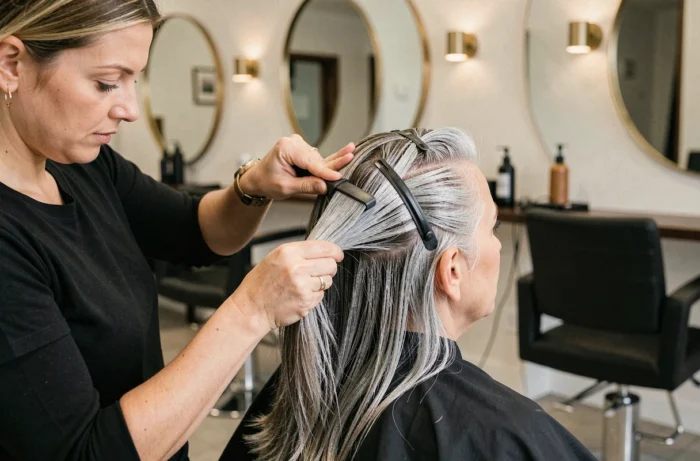
Grey Blending and Commercial Vocabulary: Quiet Silver, French Blending
The market has multiplied names around the same technique. The terms quiet silver and French blending refer to positioning variants rather than distinct protocols. A “quiet silver” in Oprah Daily or InStyle describes exactly the same principle of gradual blending as grey blending in a French salon.
This proliferation of terminology complicates communication with clients. We recommend always returning to the technical diagnosis rather than the name of the service. The percentage of white hair, texture, color history, and desired result determine the protocol, not the marketing label.
Grey blending is no longer a niche technique. Yelp data relayed by Axios confirms a sharp increase in demand since 2025, driven by a change in perception. Gray hair is now an aesthetic choice, not a resignation. Some clients alternate between keeping their white visible, toning it, or temporarily returning to coloring, in a logic of hair freedom rather than irreversible transition. It is this flexibility that ensures the longevity of the technique.