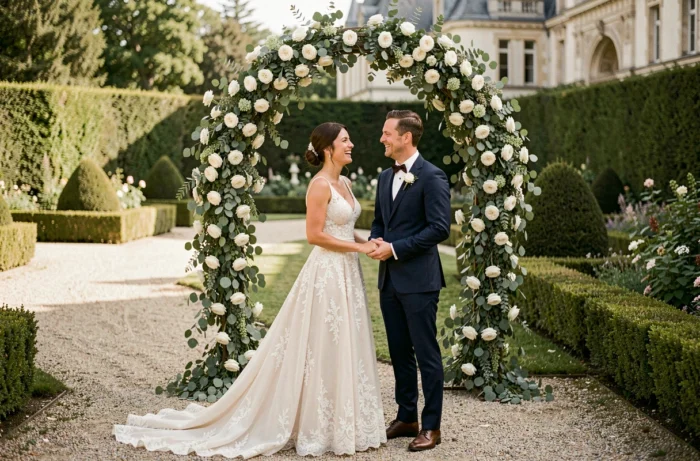
Organizing a wedding involves coordinating dozens of decisions over several months, with a finite budget and vendors whose schedules fill up quickly. The word “organization” actually encompasses three distinct areas: logistics (venue, date, catering), staging (decor, ceremony, atmosphere), and administrative tasks (town hall paperwork, contracts, insurance). Making this distinction from the start helps avoid mixing urgent needs with desires.
Budget Allocation: Where to Focus Spending for a Successful Wedding
Most guides suggest setting a global budget and then distributing it by category. This approach masks a more foundational choice: defining two or three non-negotiable categories before allocating the rest.
A couple who values photography and catering will make different trade-offs than a couple who prioritizes the reception venue. Identifying priorities helps protect emotionally significant categories and allows for reductions in others without frustration.
Field reports published by La Dépêche in September 2026 confirm a trend: requests for receptions for around 80 people are becoming more frequent, compared to 200 guests previously. Reducing the guest list remains the most direct budget lever, as each additional guest simultaneously impacts catering, furniture rental, stationery, and beverages. Resources available on Blog Mariage detail this type of trade-off with concrete feedback from recently married couples.
- The venue and catering typically represent the largest portion of the total budget, making them the two categories to secure first.
- Floral decoration can be reduced by prioritizing seasonal French flowers, a choice that also limits the wedding’s carbon footprint.
- Real-time content creation (stories, reels filmed on the big day) constitutes a new category: according to the Journal des femmes, 35% of engaged couples surveyed favor a content creator distinct from the photographer.
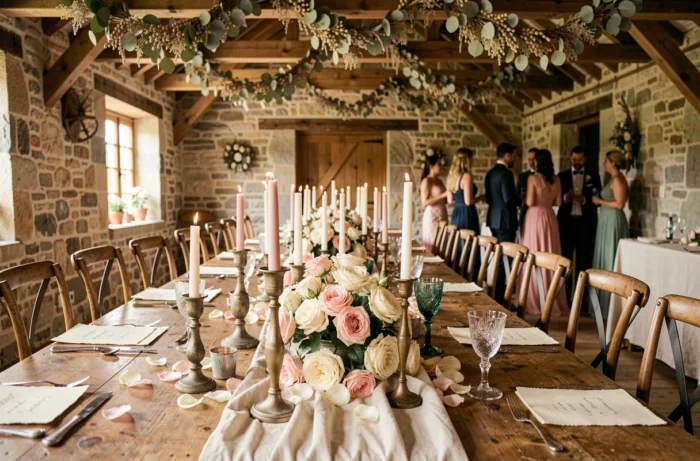
Two-Day Wedding: Anticipating the Weekend Format
The wedding concentrated on a single evening is gradually giving way to a format extended over two days. A Vows & Venues survey conducted by Hyatt among 2,000 people, cited by Gala in September 2026, indicates that 56% of respondents wish to organize a brunch the day after the ceremony.
This format profoundly changes the logistics. A second catering service, group or nearby accommodation, and sometimes a second venue rental contract must be planned. The next day’s brunch is not just a festive extension: it is a standalone event, with its own catering, staffing, and timing constraints.
What the Weekend Format Changes Practically
The first impact affects the reception venue. A property that offers on-site accommodation simplifies coordination, but its rental fee then covers two days instead of one. Negotiating a weekend package during the first visit avoids unexpected costs discovered too late.
The second impact concerns vendors. Photographers, DJs, or music groups often charge an additional fee for being present the next day. It is better to include this option in the initial quote request rather than adding it after signing the contract.
Guest List and Seating Plan: Decisions That Condition Everything Else
The guest list is not a social formality. It is the document that determines the venue size, catering budget, and seating arrangement. Finalizing it too late creates a domino effect on all other categories.
An effective method involves creating three lists: those whose absence would be unthinkable, those whose presence is desired, and those invited out of convention. When the budget requires trade-offs, the third list absorbs cuts without affecting the day’s atmosphere.
Seating Plan: Start with Constraints, Not Affinities
The seating plan works best when starting with hard constraints: people with reduced mobility near access points, families with children close to exits, and witnesses near the head table. Placing logistical constraints first frees up flexibility to group guests by affinity later.
Planning a backup table (one extra seat for every ten guests) absorbs last-minute confirmations without disrupting the overall arrangement.

Outdoor Secular Ceremony: Legal Framework and Practical Constraints
Outdoor ceremonies are gaining popularity, driven by a desire to personalize the vow moment outside of a religious framework. The secular ceremony has no legal value in France: the town hall visit remains mandatory for the marriage to be recognized by law.
Practically, an outdoor ceremony requires a weather contingency plan. Planning for a backup tent or a nearby covered space is not an excessive precaution: it is a clause that most officiants of secular ceremonies request before accepting a service.
Sound and Acoustics Outdoors
Wind, ambient noise, and the absence of walls make sound reinforcement more demanding than indoors. A lapel mic for the officiant and the couple, coupled with two speakers facing the guests, suffices in most setups for up to 120 people. Testing the equipment the day before, at the exact location, remains the only way to ensure that the vows will be audible from the last row.
The choice of ceremony venue also conditions the decoration. A natural setting (forest, lakeside, botanical garden) requires less floral arrangement than a neutral space, which lightens both the budget and setup time.
The contemporary wedding is distinguished less by its decorative theme than by the quality of its logistical trade-offs. A realistic budget, an early stabilized guest list, and a clearly defined format (a day or a weekend) form the foundation upon which all other decisions rest. The rest, from flowers to musical choices, adjusts more easily once this framework is established.