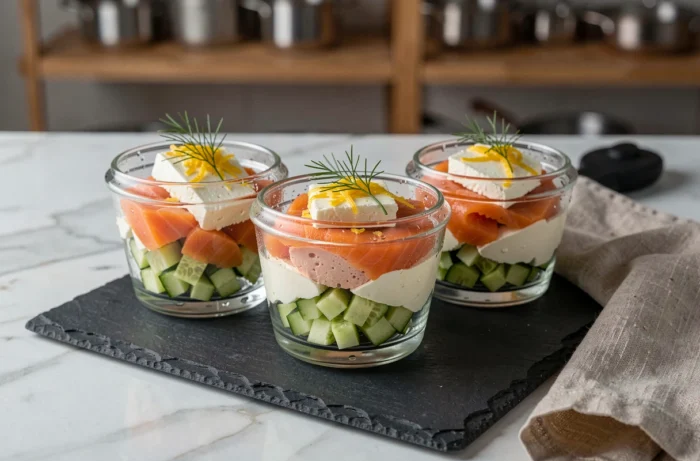
Preparing savory verrines the day before an event helps eliminate the stress of the big day. The principle seems simple, but not all recipes can withstand a night in the refrigerator in the same way. The texture of a mousse, the firmness of an avocado, the behavior of raw fish after several hours in the cold: each ingredient imposes its own limits.
Here are ten concrete recipes, accompanied by precautions that make the difference between a successful verrine and a watery glass.
Cold chain and savory verrines: what preparing the day before really requires
Recipes for verrines to prepare in advance circulate widely, but few specify the storage conditions. According to recommendations from the Ministry of Agriculture and Anses, a preparation containing sensitive ingredients (fish, eggs, cream, fresh cheese) should not remain at room temperature for more than two hours before refrigeration.
The coldest area of the refrigerator should be maintained at 4 °C or lower. Placing your verrines in the door or on a high shelf exposes fragile ingredients to insufficient temperatures. For verrines with salmon, crab, or fresh cheese, the bottom drawer or cold zone remains the only suitable location.
The often-cited 24-hour timeframe is not a universal guarantee. It depends on the recipe, the actual temperature of the refrigerator, and strict adherence to the cold chain. A verrine of grilled vegetables in olive oil will hold up better than a verrine of raw salmon topped with fresh cream. You will also find gourmet ideas on Vidéos du Net that illustrate this diversity of recipes suitable for advance preparation.
Cream and fresh cheese verrines: stable recipes for the day before
Preparations based on fresh cheese or thick cream are among the most reliable for preparing the day before. Their texture remains homogeneous after a night in the cold, provided they are not lightened with too much liquid.
Fresh goat cheese mousse, candied tomatoes, and basil
Whip fresh goat cheese with a spoonful of olive oil until smooth. Place a spoonful of candied tomatoes at the bottom of each verrine, then the mousse, and finish with a basil leaf. Fresh goat cheese does not release water in the refrigerator, ensuring a clean texture the next day.
Salty panna cotta with parmesan and pepper coulis
A salty panna cotta set with gelatin offers perfect stability after 12 to 18 hours of refrigeration. Heat cream with grated parmesan, add hydrated gelatin, and pour into the verrines. The pepper coulis is poured on top once the panna cotta is set.
Avocado verrine, thick fresh cream, and lime
Avocado browns quickly when exposed to air. To circumvent this problem, cover the surface with a thin layer of lemon cream that acts as a barrier. Mash the avocado with lime juice, top with seasoned thick cream, then cover with plastic wrap. The result remains green and creamy the next day.
Fish and seafood verrine recipes for appetizers
Fish and seafood bring a festive touch, but their storage requires more rigor. Smoked salmon keeps well in the cold, while preparations with raw fish (tartare, ceviche) do not fare well overnight.
Smoked salmon, fresh cheese, and dill verrine
Alternate a layer of fresh cheese mixed with chopped dill and strips of smoked salmon. This classic appetizer recipe holds up perfectly the day before because smoked salmon retains its texture in the refrigerator.
Crab rillettes, avocado, and grapefruit
Flake the crab meat, mix it with a drizzle of olive oil and lemon juice. Place a base of mashed avocado, the crab rillettes, and then grapefruit segments. The grapefruit is prepared separately and added just before serving to prevent it from soaking the rest.
Express salmon tartare to assemble on the day
Fresh salmon tartare does not hold up well overnight. Prepare the base (chopped shallot, capers, seasoning, sauce) the day before and keep the raw salmon separately, wrapped tightly. The final assembly takes less than five minutes on the day itself.
Vegetarian and Mediterranean verrines: the most tolerant recipes
Verrines made with vegetables, olive oil, and starches are among the most tolerant for advance preparation. The absence of raw animal proteins simplifies storage.
Tomato gazpacho in a verrine
A well-seasoned gazpacho gains flavor after a night in the refrigerator. Blend ripe tomatoes, cucumber, bell pepper, olive oil, and sherry vinegar. Pour into the verrines and keep covered. The texture remains fluid and the flavors concentrate.
Smoked eggplant caviar, hummus, and sesame seeds
Layer a layer of smoked eggplant caviar and a layer of hummus. Both preparations are stable in the cold and do not mix due to their respective thickness. Sesame seeds and a drizzle of olive oil are added at serving time to preserve the crunch.
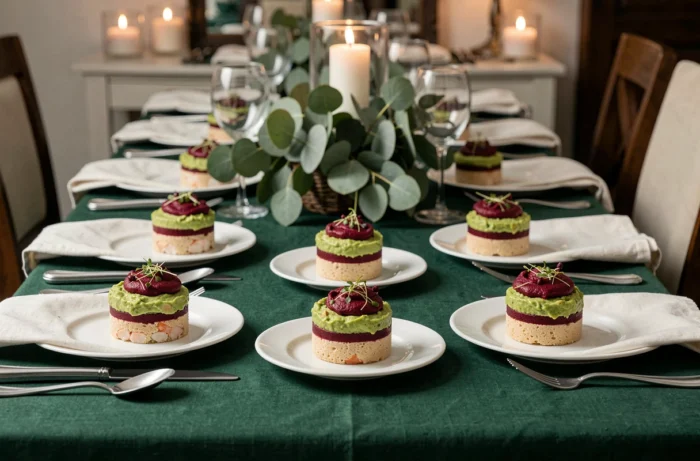
Beetroot, goat cheese, and walnut verrine
Blend cooked beetroot with a touch of balsamic vinegar. Place this base in the verrines, add a scoop of fresh goat cheese. The walnut halves are added at the last moment to maintain their texture.
Assembly order and toppings: gestures that protect texture
The success of a verrine prepared the day before depends as much on the order of the layers as on the recipe itself. A few concrete principles avoid disappointments:
- Always place the densest and wettest elements at the bottom (coulis, compote, candied vegetables) and the mousses or creams above to limit water migration.
- Wrap each verrine individually with plastic wrap. Air accelerates the oxidation of ingredients like avocado and dries out the mousses on the surface.
- Add crunchy toppings at the time of serving: seeds, croutons, fresh herbs, nuts. A night in the refrigerator systematically softens them.
- If the recipe contains an acidic ingredient (citrus, fresh tomatoes, vinaigrette), isolate it in a separate container and assemble at the last moment to prevent the acidity from “cooking” the other layers.
These precautions apply to almost all savory verrines for appetizers. They transform an ordinary recipe into a reliable preparation, even after a full night in the refrigerator.
The verrine prepared the day before remains an ideal format for entertaining without spending the evening in the kitchen. The true criterion for success is not the complexity of the recipe, but the choice of ingredients that tolerate the cold and an assembly designed for longevity. Ten well-designed verrines, taken out of the refrigerator thirty minutes before serving, will make a greater impact than an improvised buffet in a hurry.