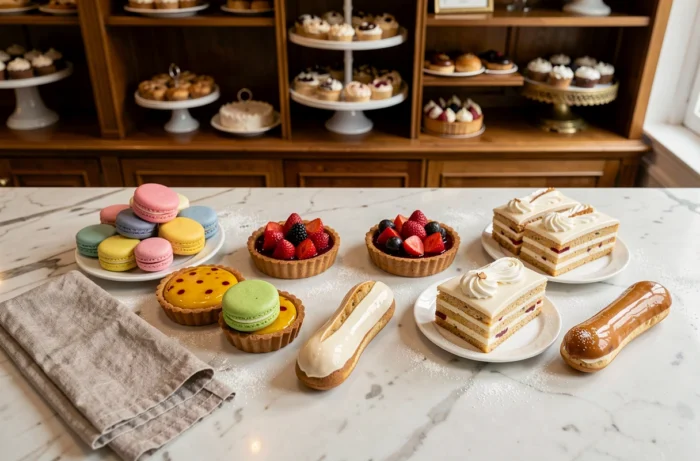
The reformulation of desserts no longer relies on the subtraction of a single ingredient. We are observing a clear technical shift in gourmet pastry: functional enrichment replaces the simple reduction of sugar, and textures become a lever for differentiation as strategic as taste itself.
Protein enrichment and fibers in pastry: the new specifications
The bakery sector is now focusing its innovation efforts on the addition of proteins and fibers in desserts, while reducing sugar, additives, and sodium. This is no longer a niche segment reserved for fitness brands.
We recommend integrating this logic from the recipe design stage, not in post-formulation. A tart crust enriched with chicory fibers or pea proteins alters the behavior of the dough during baking, water retention, and the final texture. Working on these parameters upstream avoids costly corrections with flavor enhancers.
Allulose, a rare sweetener gaining traction at the industrial level, illustrates this trend. It replicates the caramelization profile of sucrose without adding to the glycemic load. Its ability to maintain the Maillard reaction distinctly sets it apart from erythritol or stevia, which are often disappointing in baked pastries.
Professionals who follow regulatory news on monde-gourmandises.net will note that the status of allulose is still under evaluation in the European Union, which further hinders its adoption in French artisanal production.
Regulatory transparency on sugars and jams: what changes for pastry chefs
A French decree published in April 2026 transposed a European directive from 2024. Three technical points deserve the attention of sweet professionals.
- The minimum fruit content in jams has been raised, altering the formulation ratios for tart fillings, desserts, and filled pastries.
- New categories of fruit juices are emerging, with explicit mention of added sugars, complicating the labeling of desserts incorporating coulis or juice-based inserts.
- The transparency rules regarding honey are tightening, a direct issue for pastries using honey as the main sweetener in financiers, nougats, or gingerbreads.
These developments are not cosmetic. They require a review of the technical sheets for finished products sold in stores and on marketplaces, under penalty of non-compliance starting in the fall of 2026.
Contrasting textures in desserts: beyond crunch and melt
The crunch-melt duo has become a cliché. Current pastry trends push textural work towards less predictable combinations: cold cream on warm biscuit, soft gel against grainy praline, airy mousse trapped under a thin crunchy crust obtained by blowing.
The technique of isomalt sugar blowing, long confined to artistic pieces, is migrating to plated desserts. It allows for the creation of ultra-thin translucent shells that burst in the mouth and release a liquid or semi-liquid filling.
We are also seeing a return of inverted puff pastry in desserts, not just in mille-feuilles. Inverted puff pastry (butter on the outside of the dough) produces a more durable crispness and a clearer bite. This is a concrete advantage for individual formats intended for takeout, where texture retention over several hours remains a major technical challenge.
Tart and fermented flavors in new pastries
Controlled acidity has become a full-fledged formulation tool. Consumers, saturated by linear sweet profiles, respond positively to tart flavors integrated into cakes and desserts.
Yuzu and kaffir lime remain safe bets, but the real novelty lies in the use of fermented ingredients. Fruit kefir as an insert, white miso in caramel, reduced apple cider vinegar in glaze: these choices create a flavor depth that sugar alone cannot produce.
The point of caution is dosage. An overly acidic kefir insert can unbalance a milk chocolate dessert. We recommend calibrating the total titrated acidity of the insert before assembly, aiming for a pH between 3.8 and 4.2 for a perceptible result without aggressiveness.
Reduced formats and individual desserts: a technical constraint, not just a marketing format
The reduction in format is not just a response to the demand for controlled consumption. It imposes technical trade-offs that are often underestimated.
- The surface-to-volume ratio increases, which accelerates drying. An 80 g individual dessert loses its moisture two to three times faster than a 500 g format.
- Inserts must be reformulated: an insert designed for an 18 cm dessert cannot simply be cut down to a smaller size. The proportion of gelling agent must be adjusted to maintain the mouthfeel in a reduced volume.
- The mirror glaze reacts differently on a small surface, with increased risks of drips and visible grid marks. The appropriate viscosity of the glaze must be recalibrated.
These constraints explain why successful individual dessert recipes are not mere scale-ups of classic formats. Each component requires specific development.

The trends in gourmet pastry for 2026 converge towards a single imperative: technical mastery takes precedence over visual effect. A fiber-enriched dessert that crumbles or a reduced format that dries out in two hours will not appeal to anyone, regardless of its photogenicity on social media. The sweet treats that will stand out this year will be those whose formulation has been thought out with as much rigor as the presentation.