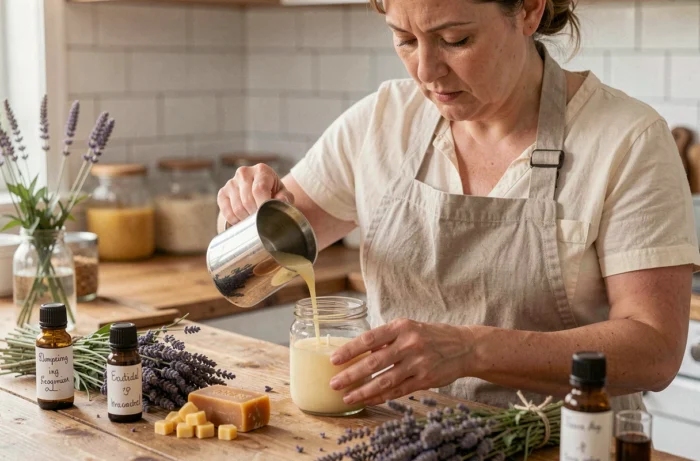
A vegetable candle is a candle whose fuel comes exclusively from plant-based fats (soy, rapeseed, coconut) or beeswax, as opposed to paraffin derived from petroleum. Making your own vegetable candles at home requires understanding the thermal behavior of each wax, the sizing of the wick, and the regulatory constraints related to fragrance. The outcome depends less on the chosen recipe than on mastering these three parameters.
Melting point and shrinkage: what vegetable wax changes in practice
Paraffin melts at a relatively high temperature and solidifies uniformly. Vegetable waxes, on the other hand, have a lower melting point, which alters the entire manufacturing chain.
Soy wax melts slowly and produces a smooth surface if the cooling is slow and steady. Rapid cooling causes surface cracks or detachment along the container. Rapeseed wax behaves similarly, with a slightly creamier texture once solidified.
Beeswax, for its part, requires a higher heating temperature. It produces a harder candle that burns more slowly, but it is less easy to scent because its natural honey smell partially covers the added fragrances. Mixing a portion of vegetable oil (coconut or apricot) with beeswax helps limit cracks and soften the texture.
In practical terms, each wax imposes its own pouring temperature window. Pouring too hot encourages air bubbles, while pouring too cold prevents the wax from adhering to the container. The only reliable method is to use a kitchen thermometer and note the exact pouring temperature for each trial, to replicate the result.
Several methods for making homemade vegetable candles detail these temperature ranges according to the type of wax used, which helps avoid multiple failed attempts.
Wick sizing: the most underestimated parameter
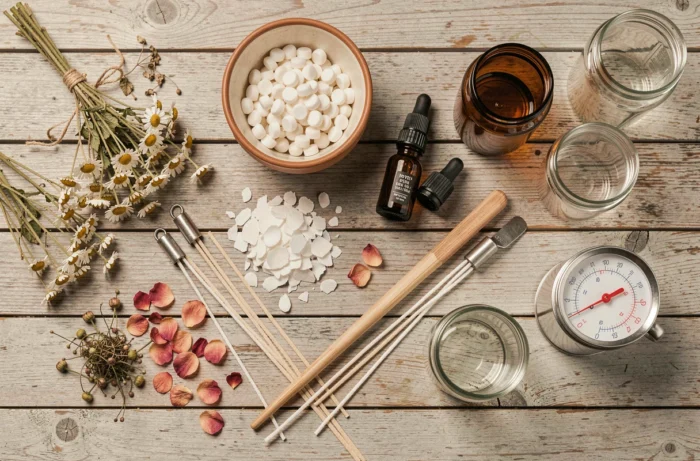
The wick determines the size of the melted wax pool, the burning speed, and the amount of soot produced. A wick that is too thin will not melt the wax to the edges of the container, creating a tunnel in the center. A wick that is too thick will produce a tall flame, black smoke, and too rapid combustion.
The diameter of the container is the starting criterion. For a small container, a small gauge braided cotton wick is sufficient. For a wider container, a larger gauge is needed, or even multiple wicks.
Cotton, wood, or hemp wicks
- Waxed braided cotton wicks are the most common and predictable in soy or rapeseed wax. They provide stable combustion and minimal residue.
- Wood wicks produce a characteristic crackling sound, but their sizing is trickier: they require an open container and sufficiently fluid wax to sustain the flame.
- Hemp or linen wicks, sometimes coated with beeswax, are suitable for candles without containers (pillars, molded candles) and burn more slowly.
Testing the wick before producing a batch remains the only reliable approach. Pouring a test candle, letting it burn for a few hours, and observing the diameter of the melted wax pool allows for adjusting the size before starting a series.
Scenting a vegetable candle without phthalates or restricted compounds
Scenting is the stage where health-related errors are most common. Cheap synthetic fragrances sometimes contain phthalates used as fragrance fixatives. In Europe, several phthalates classified as endocrine disruptors are now banned in scented candles and consumer ambient products.
For domestic use, two options remain safe:
- Pure essential oils (lavender, eucalyptus, citrus) provide a natural scent but evaporate quickly with heat. Adding them to warm wax just before pouring limits aromatic loss.
- Cosmetic fragrances without phthalates, formulated for combustion, diffuse better and longer than essential oils. Check that the supplier indicates IFRA (International Fragrance Association) compliance on the technical data sheet.
The amount of fragrance should not exceed a certain threshold relative to the weight of the wax. Too much fragrance weakens the structure of the candle and can cause uneven burning with splashes of melted wax. Adhering to the dosage recommended by the wax supplier protects both the quality of the candle and indoor air quality.

European regulation and labeling: what applies even to DIY
The European regulation on general product safety applies to candles and scented indoor products. It complements the CLP (classification of hazardous substances) and REACH (restriction of certain chemical substances) rules.
For strictly personal use, these obligations have no direct impact. However, as soon as a candle is sold or offered in a semi-professional context (craft markets, online shops, associations), the creator must ensure the traceability of the ingredients, label any allergens present in the fragrance, and comply with REACH restrictions.
Points to check before selling
The label must mention the possible presence of allergens among the list of substances requiring declaration. The container must bear the CLP pictogram if the fragrance contains compounds classified as irritants or sensitizers. Ignoring these obligations exposes one to penalties, even for small volumes.
Public tutorials almost systematically overlook this regulatory dimension. Checking the safety data sheets for each fragrance before incorporating them remains the most protective reflex, whether the candle is intended for your living room or for sale.
The choice of wax, the sizing of the wick, and the compliance of the fragrances form a technical triangle where each decision influences the other two. A successful homemade vegetable candle relies less on the recipe itself than on the rigor of prior testing and the traceability of the raw materials used.