
Organizing a wedding involves a series of interconnected decisions. The choice of venue determines the date, the number of guests dictates the catering budget, and the matrimonial regime must be settled with a notary before the ceremony, not after. Here are ten concrete steps, listed in no particular order, to structure your preparations without leaving anything to chance.
1. Submit the marriage application at the town hall on time

People often think about the venue and the caterer before considering the town hall. However, Articles 63 to 76 of the Civil Code outline the required documents, the publication of the banns, and the conditions for the ceremony. The application must be submitted in the municipality where the celebration or the couple’s eligible residence takes place.
The publication of the banns lasts at least 10 days before the celebration. The civil registrar may also request a preliminary interview with the future spouses, a control step that affects the timeline. It is recommended to submit the complete application at least two months before the targeted date to accommodate these administrative delays.
2. Clarify the matrimonial regime with a notary

Without a signed contract before the ceremony, the legal regime of community property applies automatically. Many couples discover this rule too late. If one partner owns real estate, works independently, or has debts, a visit to the notary is not optional.
Several options exist (separation of property, universal community, participation in acquisitions). The notary appointment should ideally be scheduled several months before the wedding, as the drafting and signing of the contract must be finalized before the day of the civil ceremony. Dedicated resources on wedding planning on Actu Mariage allow for a deeper exploration of each aspect of preparation.
3. Set a global budget before contacting any vendors

A fundamental point: without a set budget, every quote received becomes a source of stress. First, list the categories (venue, caterer, photographer, decoration, attire, entertainment, invitations), then assign a percentage to each.
Allowing a margin for unexpected expenses avoids painful trade-offs at the end of preparations. Commonly underestimated costs include: tips, alterations for attire, venue administration fees, and equipment rentals (sound system, furniture, lighting).
4. Draft the guest list in two rounds

First round: each partner lists all the people they wish to invite without filtering. Second round: the two lists are compared against the budget and the venue’s capacity. This method prevents omissions and family tensions.
Next, distinguish between guests for the civil ceremony (often a small circle, as town halls have limited capacity) and those for the reception. The final number of guests influences the choice of venue and the catering quote, hence the importance of stabilizing this list early.
5. Book the reception venue at least a year in advance

Popular venues are often booked well in advance, sometimes more than a year before the date. Before signing, check several concrete points:
- The actual capacity (seated, standing, on-site or nearby accommodation)
- The time and noise constraints imposed by the municipality
- Accessibility for guests with reduced mobility and the availability of parking
- What is included in the rental (furniture, equipped kitchen, staff) and what remains your responsibility
Visiting the venue on a rainy day gives a more realistic idea than a visit on a sunny day. Feedback varies on this point, but having a weather backup plan (tent, alternative indoor space) remains a useful safety net.
6. Select key vendors with comparative quotes

Caterer, photographer, DJ or band, florist: these four vendors absorb a large part of the budget. Request at least three quotes per category, comparing not only the price but also the included services (number of hours, deliverables, travel expenses).
Reading each contract in full before signing may seem obvious, but cancellation clauses and non-refundable deposits are often sources of disputes. Note the confirmation deadlines and payment due dates in a shared calendar.
7. Choose the type of ceremony and its officiants

Civil wedding only, religious ceremony, secular ceremony, or a combination of the three: each format has its logistical constraints. The civil ceremony at the town hall is mandatory for the union to be legally recognized. A secular ceremony can be planned freely but requires an officiant and a script.
Witnesses must be chosen and informed in advance. In terms of planning, schedule the ceremony rehearsal the day before or two days prior, especially if readings or musical performances are planned.
8. Send invitations with a follow-up calendar

A save the date goes out six to eight months in advance, the detailed invitation three to four months before. Set a response deadline and plan a follow-up for late responders. Confirming the final number of guests at least three weeks before the big day allows for adjustments to the seating plan and the caterer.
Paper format, digital, or both: the choice depends on the profile of the guests. The invitation includes practical information (venue, timings, possible dress code, link to the gift registry).
9. Plan outfits and fittings several months in advance
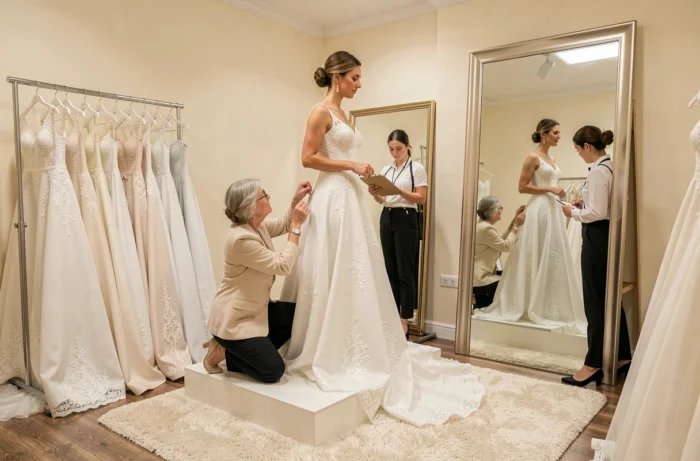
Custom or ordered dresses often require several months for production, plus two to three fitting sessions. Custom suits follow the same timeline. The first appointment should be made at least six months before the date.
Accessories (shoes, veil, jewelry, boutonniere) should be chosen after the main outfit to ensure coherence. Also consider the outfits for the witnesses and the flower children, which require their own fittings.
10. Create a shared timeline with all deadlines

A spreadsheet or project management tool shared between the two partners (and possibly the wedding planner) centralizes all deadlines:
- Dates for submitting the application at the town hall and publishing the banns
- Signing of vendor contracts and payment deadlines
- Fittings, tastings, ceremony rehearsal
- Sending invitations, following up on responses, confirming the caterer
Each task has an owner and a deadline. This document should be updated weekly in the last three months. The timeline accommodates delays and allows for proactive responses before an oversight becomes an issue on the big day.
Wedding planning relies less on the perfection of every detail than on the robustness of the framework established in advance. An early submitted administrative file, a stabilized budget, and an updated timeline form the foundation upon which everything else rests.