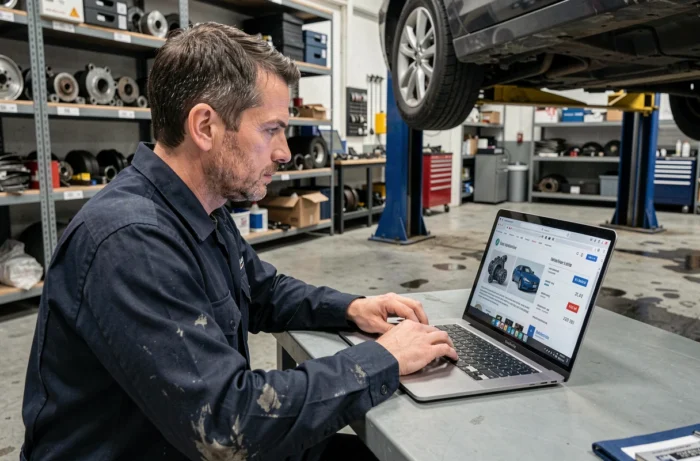
Are you looking for an oil filter reference or an engine mount for your Clio, and the generic online catalog returns three results incompatible with your engine type? The problem rarely lies with the part itself: it comes from the vehicle identification. New Dialogys, Renault’s after-sales portal, was designed to solve this issue by linking each parts search to the VIN number of the concerned vehicle.
Why the VIN changes everything in the search for Renault parts
A single Renault model often exists in dozens of variants. Between engine versions, trim levels, and optional factory-installed equipment, two Clio models from the same year may require different parts for something as mundane as a mirror or a bumper support.
The old Dialogys software, with its last downloadable version dating back to late 2019, required manual navigation through trees by model, then by engine variant, and then by year. Reference errors were common, especially on vehicles produced in multiple configurations within the same generation.
New Dialogys addresses this problem by placing the VIN number (or license plate) as the main entry point. Once the VIN is entered, the platform automatically filters the catalog to display only the parts compatible with the exact configuration of the vehicle. Have you ever ordered a “compatible Mégane” brake disc only to find it didn’t match your version? This VIN filtering eliminates such mishaps.
To delve deeper into the complete method, you can use new Dialogys Renault online by following a step-by-step guide that details each screen of the platform.
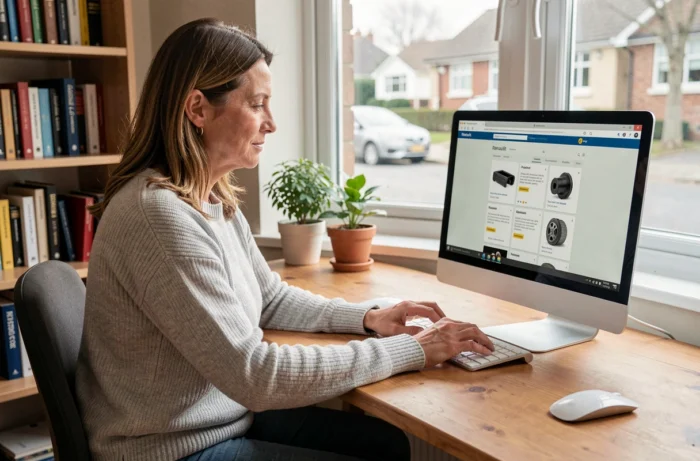
Parts for electric and hybrid E-Tech vehicles: an underestimated difficulty
Most guides on New Dialogys focus on thermal models. The rise of E-Tech ranges (100% electric, hybrid, and plug-in hybrid) since 2023-2024 has introduced additional complexity into the parts catalog.
High-voltage components are not interchangeable between a thermal version, mild hybrid, full hybrid, and plug-in of the same model. A charging cable, battery management unit, or charging accessory must be precisely identified by the VIN to avoid reference errors.
Let’s take a concrete example. On a Captur E-Tech plug-in hybrid, the cooling system includes a circuit dedicated to the traction battery, which is absent in the thermal version. Ordering a “compatible Captur” thermostat without specifying the exact engine type risks receiving an unusable part.
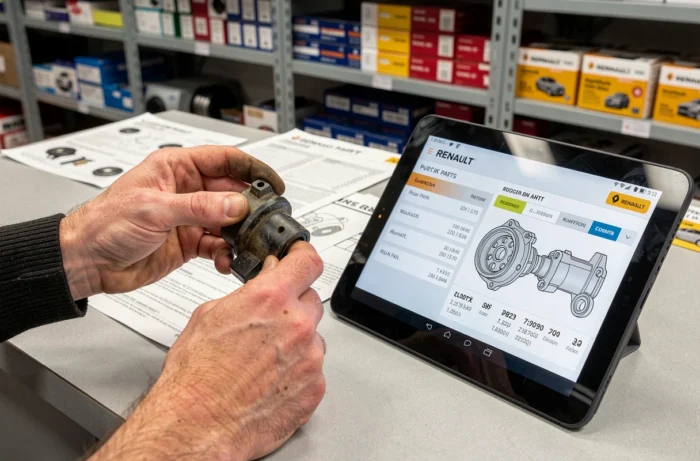
In New Dialogys, entering the VIN resolves this ambiguity. The electronic parts catalog (EPC) displays the exploded diagrams corresponding to the actual configuration of the vehicle, including sub-assemblies specific to the electric or hybrid powertrain.
Renault technical documentation: beyond just a parts catalog
New Dialogys is not limited to a catalog of references. The platform provides access to several types of technical documentation that change the way an intervention is prepared.
- Exploded diagrams and 3D views: each sub-assembly of the vehicle is represented with the exact positioning of parts, allowing for the identification of fasteners or seals often overlooked during an order.
- Repair methods and torque specifications: the manufacturer’s official procedures indicate disassembly steps, specific tools required, and torque values, data that is absent from general catalogs.
- Standard times: each operation is associated with a standard time, useful for independent garages that bill by the hour and for individuals wanting to estimate the duration of an intervention.
This documentation is continuously updated, unlike the old Dialogys which operated with DVDs or sporadically downloaded files. When Renault publishes a technical note on a recurring defect (a revised engine mount, a modified wiring harness), the information appears directly in the online database.
ASOS portal and single diagnostic session
Since its integration into the Renault ASOS portal, New Dialogys functions as a documentation brick in a unified diagnostic pathway. A technician who initiates an online diagnosis on a recent vehicle can switch to New Dialogys documentation without needing to re-authenticate or re-enter the VIN.
This session continuity avoids back-and-forth between tools. The diagnosis points to a faulty sensor, and the documentation immediately displays the replacement method and the corresponding part reference.
Access for independents and individuals: what is actually possible
New Dialogys was designed for professionals in the Renault network. Access requires an account and a subscription, raising a legitimate question: can an independent mechanic or an experienced individual use it?
Officially, the platform targets after-sales professionals. Authorized garages access it through their agreement with the manufacturer. Independents (non-authorized garages, self-employed) can request access, but the conditions vary.
User feedback on specialized forums in 2024 indicates a growing tolerance towards “independent” accounts ordering original parts through the catalog. Access remains limited, but it reflects a market trend where European regulations are pushing manufacturers to make their technical documentation accessible to independent repairers.
For individuals, direct access to New Dialogys remains marginal. The most common solution is to ask a mechanic equipped to extract the exact part reference and then order it separately if the network price is not suitable.
Points to check before subscribing
- Browser compatibility: New Dialogys operates via a web portal, but some features require a recent browser and a stable connection.
- Coverage area: the platform covers Renault, Dacia, and Alpine vehicles, but very old models (pre-2000) may have incomplete documentation.
- Subscription cost: it varies depending on the type of access (documentation only, parts catalog, integrated diagnostics), and the professional rate differs from that offered to independents.
The transition from the old Dialogys to New Dialogys has simplified parts searching by centralizing everything on a single portal, updated in real-time. Entering the VIN as the main filter remains the most useful action to avoid compatibility errors, whether the vehicle is thermal, hybrid, or electric. For professionals as well as for experienced DIYers, mastering this tool saves time with every parts order.