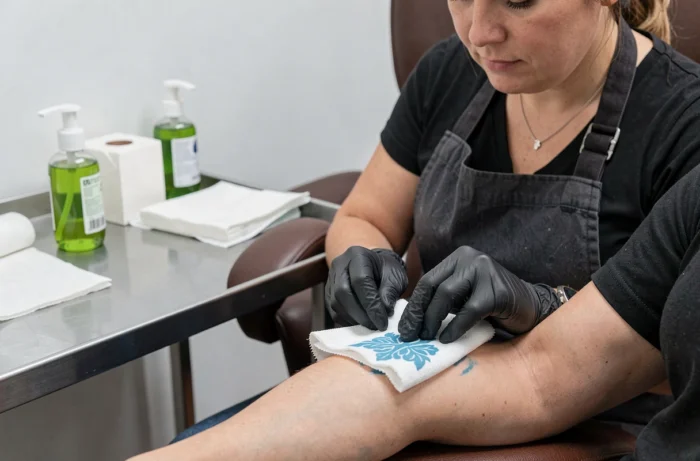
Removing a tattoo stencil after a session may seem trivial, but the skin has just undergone thousands of micro-perforations. The choice of product and cleaning method directly influences the quality of healing. Several methods coexist, from isopropyl alcohol to specialized removers, as well as simple greasy substances. Each has its limits, and feedback from tattoo artists varies on this point depending on skin type and ink used.
Patch test before stencil removal: a rarely mentioned precaution
Stencil removal guides focus on the rubbing technique and the choice of solvent. They almost systematically overlook a preliminary step: the skin test.
Specialized post-tattoo care guides recommend testing the product on a small area of healthy skin 24 hours before the session. This precaution is primarily aimed at sensitive, atopic, or acne-prone skin, but it remains relevant for anyone using a stencil remover for the first time.
The principle is simple: apply a drop of the product on the inside of the wrist or behind the ear, cover with a bandage, and observe the reaction the next day. Persistent redness, itching, or swelling indicates incompatibility. The article detailing how to remove the tattoo stencil on Un Temps Pour Ma Peau also discusses the basic steps to protect the tattooed area during this stage.
This test applies to both solvent sprays and pre-soaked wipes, which often contain preservatives or fragrances that may trigger contact dermatitis.
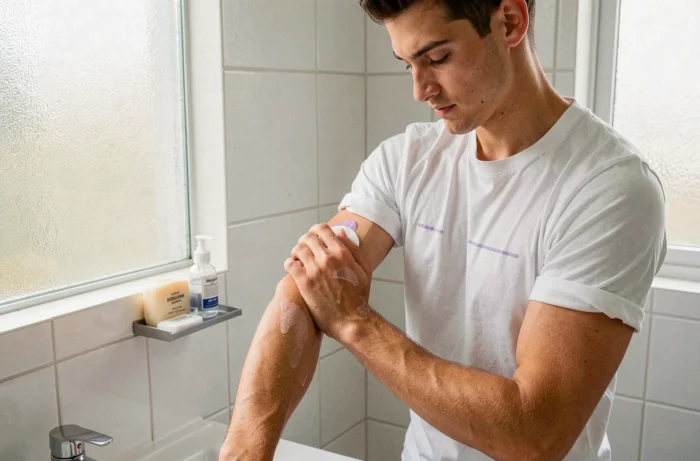
Stencil remover, alcohol, or greasy substances: what each method does to the skin
Three main categories of products dominate the practice. Their effects on freshly tattooed skin are not equivalent.
Dedicated stencil removers
Products like Aloe Tattoo Stencil Eraser or Black Booze are formulated to dissolve the thermal ink of the stencil without attacking the already implanted pigments. Most contain aloe vera or moisturizing agents intended to limit irritation.
However, some removers incorporate solvents, fragrances, or preservatives whose exact composition is not always detailed on the label. The available data do not allow us to conclude that all these products are neutral for reactive skin. Choosing a remover that is alcohol-free and fragrance-free remains the most cautious recommendation for sensitive skin.
Isopropyl alcohol
Alcohol remains the classic reflex in many studios. It effectively dissolves transfer ink and evaporates quickly. The problem: it dehydrates the stratum corneum and can cause a burning sensation on skin already traumatized by the needle.
On a large tattooed area or on thin skin (inner arm, neck, ribs), alcohol is more aggressive. Post-alcohol irritation delays healing if the action is repeated or too forceful.
Greasy substances: petroleum jelly and vegetable oil
Petroleum jelly and sunflower oil are used by many tattoo artists to gently remove stencil residues. The greasy substance softens the thermal ink without drying out the skin. The removal is then done with a paper towel or a compress, without aggressive rubbing.
This method is slower than alcohol or spray remover, but it has a clear advantage: no risk of allergic reaction to solvents. It is particularly suitable for atopic skin and areas where the skin barrier is fragile.
- Dedicated remover: effective and quick, but check the composition (alcohol-free, fragrance-free) and do a patch test the day before.
- Isopropyl alcohol: immediate dissolution, but possible dehydration and irritation on freshly tattooed skin.
- Greasy substances (petroleum jelly, vegetable oil): the gentlest method, suitable for sensitive skin, but requires more patience and multiple applications.
Risk of contact dermatitis after stencil removal: a under-documented angle
Discussions among tattoo artists on specialized forums regularly mention skin reactions after stencil cleaning, without always distinguishing them from a reaction to the ink itself.
Recent dermatological guides on post-tattoo skin reactions report a documented increase in contact dermatitis related to adhesives and scented products used during and after the session. Adhesive protective films (such as Dermalize or Saniderm) are studied more in this regard, but stencil removers share some irritating components: preservatives, organic solvents, texture agents.
The challenge for both the tattoo artist and the client is to distinguish three possible reactions:
- A mechanical irritation related to excessive rubbing during stencil removal.
- An allergic contact dermatitis triggered by a chemical component of the remover.
- A normal skin reaction to the tattoo session itself (redness, slight swelling).
If redness persists beyond 48 hours, accompanied by vesicles or intense itching, a dermatological consultation is necessary. The tattoo artist can note the product used to facilitate the identification of the allergen.
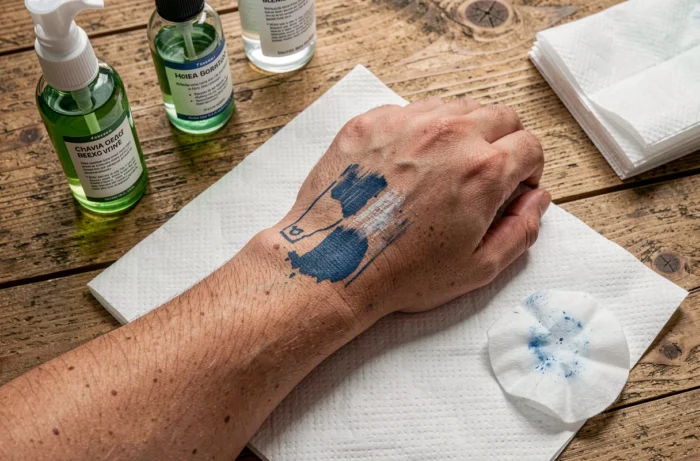
Technical gesture to remove the stencil without compromising healing
The choice of product is not everything. The way of applying and rubbing matters just as much, if not more.
The basic rule: dab rather than rub. A dabbing motion with a compress soaked in product lifts the thermal ink without tearing the already weakened surface cells. Circular rubbing, even lightly, creates micro-abrasions that prolong healing and increase the risk of pigment loss in the edges of the tattoo.
Using a non-woven compress rather than a standard paper towel reduces the risk of fiber deposits in the wound. Sterile medical-grade compresses remain the best choice, especially on large tattoos.
After removing the stencil, rinsing the area with lukewarm water (not hot) and applying a healing cream recommended by the tattoo artist helps quickly restore hydration to the skin barrier. Never remove a stencil on already dry or cracked skin without moistening it beforehand.
Removing the stencil remains a technical step in its own right, not just a simple end-of-session cleaning. The product, the gesture, and the state of the skin form a set where each variable can modify the final result on healing and pigment retention.