
Guingamp-Paimpol Agglomeration brings together 57 municipalities in Côtes-d’Armor, between the coastline (Armor) and the inland areas (Argoat). This agglomeration community exercises mandatory competencies in economic development, land planning, social balance of housing, and water management, along with optional competencies defined by its member municipalities.
Community Competencies and Service Distribution
The functioning of an agglomeration relies on the transfer of competencies from the municipalities to the intermunicipal structure. In Guingamp-Paimpol, these transfers cover essential areas for the daily lives of residents.
The economic development of community interest constitutes the first block. The agglomeration creates, develops, and manages activity zones (industrial, commercial, artisanal, tourist, port), supports local commerce, and ensures tourism promotion through its tourist offices.
The second block concerns spatial planning: territorial coherence scheme (SCoT), local urban planning plan (PLU), mobility organization. All information related to these competencies and governance is accessible on cc-guingamp.fr, which also centralizes the deliberations of the community council.
The third pillar: the social balance of housing. The local housing program guides housing policy, social housing assistance, and land reserves. The fourth aspect, the management of aquatic environments and flood prevention (GEMAPI) also falls under the agglomeration, a particularly sensitive issue during drought periods in the Trieux basin.
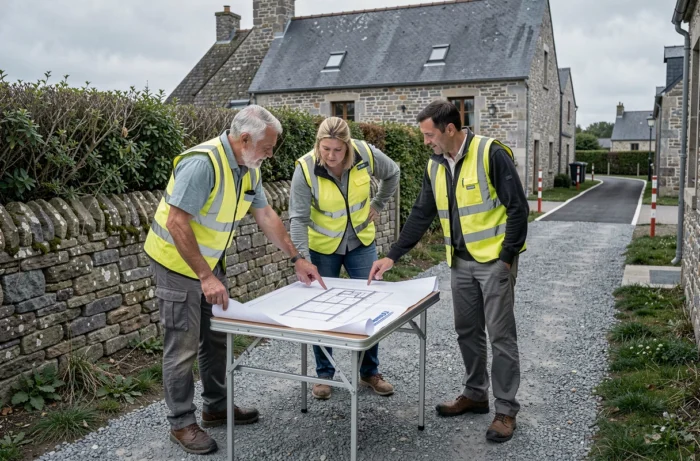
Guingamp-Paimpol Mobility: the new public transport network
The transport network of the agglomeration is undergoing significant transformation starting in the 2026 school year. From August 31, 2026, Guingamp-Paimpol Mobility will offer new routes and an enhanced service across the entire territory.
To allow residents to discover this new configuration, the agglomeration has made transport completely free for one week, from August 31 to September 6, 2026. This choice aims to remove barriers to the use of public transport in an area where the car remains the dominant mode.
Traffic Pressure Related to RN12 Works
This redeployment of the network occurs in a tense context. A renovation project on the RN12 between Ploumagoar and Plouisy, launched on August 24, 2026, is causing traffic jams during peak hours and a diversion of traffic to the secondary roads of the agglomeration’s municipalities. The works are expected to last until November 10, 2026, with traffic shifts and ramp closures.
The new bus network becomes a concrete alternative during this period of road disruption. The coincidence between the network overhaul and the RN12 construction offers an opportunity to attract new users, provided that the schedules and frequencies meet the needs of home-to-work journeys.
Community Life and Events in the Guingamp Region
The local life of the agglomeration heavily relies on its associative fabric. The associations forum, a back-to-school event in Guingamp, allows residents to discover the sports, cultural, and solidarity structures in the area each year. The 2026 edition will take place on Saturday, September 5.
The agglomeration also supports sporting events that go beyond the local framework. The Kreiz Breizh Élites Féminin 2026, a 134 km cycling race promoting women’s cycling in Côtes-d’Armor, passes through several municipalities in the territory. This type of event contributes to the visibility of the agglomeration well beyond its administrative borders.
Cultural Actions and the Fight Against Illiteracy
The agglomeration hosts the INSEAC (National Higher Institute for Artistic and Cultural Education), located in Guingamp, which serves as a unique training hub in France. Its presence structures the cultural and educational offerings of the territory.
At the same time, the National Days of Action Against Illiteracy (JNAI) lead to local events. These actions fall within the optional competencies that the agglomeration exercises in cultural policy and social support.
Water Management and Drought in the Trieux Basin
Water management represents an increasing challenge for Guingamp-Paimpol Agglomeration. The level of the Trieux, a river that crosses the territory, reveals the extent of drought episodes affecting Côtes-d’Armor. The GEMAPI competency places the agglomeration at the forefront for:
- Monitoring water levels and adapting withdrawals from the Trieux watershed
- Maintaining rivers and wetlands that act as water buffers
- Preventing flood risks by developing banks and regulating flows
- Coordinating usage restrictions in connection with prefectural drought crisis orders
The pressure on water resources necessitates rethinking usage at the scale of the agglomeration, whether it concerns agricultural irrigation, drinking water supply, or the preservation of aquatic environments.
Regional Investments and Structuring Projects
The Brittany Region has allocated 2.6 million euros for the Paimpol canton, which is part of the agglomeration’s perimeter. These regional funds aim to support development and local planning projects along the coastal fringe of the territory.
The agglomeration stands out for the diversity of its economic fabric. The agri-food sector remains the industrial backbone of the territory, but tourism, higher education (with INSEAC), and port activities around Paimpol complement the economic profile.
Jacques-Prévert College in Guingamp offers three complete cycles and attracts a growing number of students, a sign of a residential appeal that remains strong. This demographic dynamic generates needs for housing, mobility, and public services that the community council must address through constant budgetary adjustments between infrastructure investments and the ongoing operation of services for residents.